
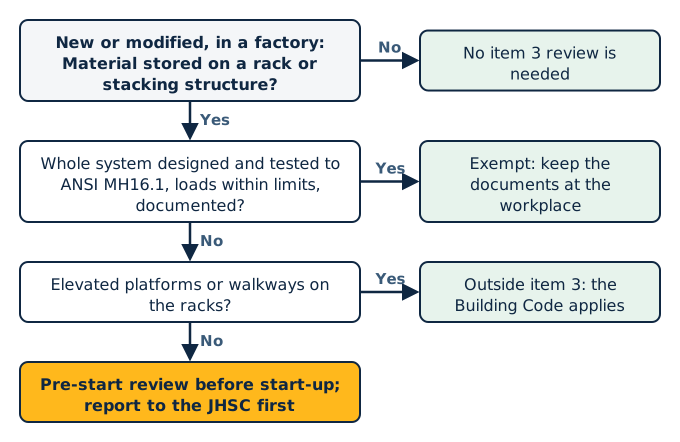
A racking PSR in Ontario is the Item 3 pre-start review an engineer completes before material is stored on new or modified racks. It isn't needed when documents show the whole rack system was designed and tested to ANSI MH16.1 and loads stay within the maker's limits. The report covers structural adequacy.
Most racking PSRs in Ontario come out of warehouse fit-outs, reconfigurations and lift truck changes rather than brand-new buildings. A distribution centre adding aisles, a plant raising beam levels for taller pallets, or a third-party logistics operator buying used frames from a closing site all land here. The review has to be finished, and the report in your joint health and safety committee's hands, before the first pallet goes up.
For a typical selective rack installation, a racking pre-start review runs $4,050 to $4,750 + HST. The figure moves with the size of the system, the rack type and how much load data you can hand over.
When Item 3 calls for a racking PSR in Ontario
Item 3 of the Table to section 7 of Reg. 851 applies when material, articles or things are placed or stored on a rack or stacking structure. The provision it ties to is clause 45(b): stored material must not tip, collapse or fall, and must be removable without endangering anyone. For the framework that applies to every Table item, start with Ontario's pre-start review rules at a glance.
The ministry guideline narrows that to racks designed to be loaded by a mechanical lifting device, usually a lift truck. That takes in selective pallet racking, drive-in and drive-through, push-back, cantilever and stacker racks, in steel, wood, aluminum or concrete. Hand-loaded shelving from a hardware store isn't part of it.
Under section 7(2), the review is needed when a new rack is installed, or when an existing one is modified and compliance needs new or changed controls. In a warehouse or plant, that looks like this:
- A new distribution centre is fitting out 2,000 pallet positions of selective racking, and the supplier's paperwork covers the beams and frames but says nothing about the system as a whole.
- You bought used racking from a closing warehouse. It has no capacity plates and nobody kept the drawings.
- Your new product runs on taller pallets, so the night shift wants to move the beam levels up 300 mm across two aisles.
- Operations is switching from counterbalance trucks to reach trucks to narrow the aisles. The guideline treats a change in the kind of lift truck as a trigger, even if nothing on the rack moves.
- Pallet weights are going up, and the new loads will exceed what the manufacturer rated the beams for.
The test is the same in every case. Either something new is going in, or something is changing in a way that affects how the rack carries its load. If you can't tell which applies, the PSR requirement checker follows the ministry's racking flow chart step by step.
Solvent drums on pallet racking bring in another item. More than 235 litres of flammable liquid in the room calls for a flammable liquids storage review under Item 1, and dispensing in the room triggers it at any quantity. That review also covers ventilation, bonding and electrical equipment around any dispensing point next to the racks.
The ANSI MH16.1 exemption covers the whole system, not the parts
Item 3 has one exemption: the rack or stacking structure is designed and tested for use in accordance with current applicable standards. The guideline names exactly one standard for this, ANSI MH16.1-2012 (R2019), Specification for the Design, Testing and Utilization of Industrial Steel Storage Racks. CSA A344 isn't on the list, and you shouldn't assume a newer MH16.1 edition is read the same way without an engineer's assessment. Racking imported from Europe or Asia hits the same wall as CE-marked machinery: whatever its home-market paperwork, the exemption needs MH16.1 documents.
The detail that catches most warehouses is the difference between components and a system. Each beam and upright frame has to be tested to the standard to validate the design, but a rack assembled from tested components can still need a PSR if there's no document that clearly says the rack as a whole is designed to MH16.1. A spec sheet for the beams isn't enough on its own.
The exemption also stops applying when the rack changes. Ministry Flow Chart 4 asks whether modifications will change the configuration, and gives moving cross beams and installing wider uprights as examples. If the answer is yes, a PSR is required. Loading past the manufacturer's limits has the same effect, because someone then has to show the structure can carry the extra weight.
When the exemption does apply, you need the supporting documents on file. The generated section further down this page lists them, and the exemption summary for all eight items shows how the rules compare.
What the engineer checks
Section 7(5)(d)(ii) says the report for Item 3 must include details of the structural adequacy of the structure. That's the core of the job. A racking PSR isn't a walk-through for dents. It's a check that the rack, as designed and as it will be loaded and served, can do what clause 45(b) requires.
The guideline lists what the review should cover:
- the design standards the rack was built to
- loading conditions and maximum capacity per level and per bay
- anchorage to the floor
- erection tolerances and the installation instructions
- the lift trucks: their capacity, turning radius and reach
The engineer works from the Building Code, the Fire Code, CSA S16, CSA S136, CSA S157 and ANSI MH16.1, among the references the guideline names. The guideline is clear that the review doesn't have to cover actual pallet loads going into the rack, and that the structural adequacy of the floor slab is outside Item 3. A careful engineer will still ask about the slab if the anchors depend on it.
For a tall system, a drive-in, or used racking with no load data, expect more analysis. The engineer may have to identify each component, measure sections and calculate capacities from scratch before writing a capacity table you can post.
Rack-supported platforms and walkways
Shelf and rack storage systems with elevated platforms or walkways are regulated by the Building Code, and the guideline puts them outside Item 3. A pick module with a mezzanine deck usually needs a building permit and design under the Building Code instead. If the same project also includes ordinary pallet racking, that racking still falls under Item 3. A building permit doesn't override the PSR requirement, though permit documents can help support an exemption.
A PSR is not your annual rack inspection
People mix these up all the time. The pre-start review happens once, before a new or changed rack is used, and the guideline puts rack damage outside its scope. Bent uprights, missing beam locks and forklift strikes are a maintenance issue, and you're still responsible for repairing them. If an inspector doubts a damaged bay, the order may instead call for an engineer's report under s.54(1)(k) before it's loaded again.
That's why most warehouses run a separate inspection program on a regular schedule. Those routine racking inspections in Ontario are a different service from this review. Repairs with manufacturer or engineer documentation saying the original capacity is maintained or restored don't trigger a new PSR. Repairs that change the configuration do.
Documents to have ready
The engineer works faster, and the fee stays closer to the typical range, when you can send these before the site visit:
- the manufacturer's or supplier's statement of design and testing, and which standard it names
- capacity tables, capacity charts or a written capacity statement
- structural drawings, component identification and the assembly details
- installation and use instructions, including anchor specifications
- the rack layout with aisle widths, bay sizes and beam elevations
- lift truck make, model, capacity and reach for every truck that will serve the rack
- the heaviest planned load per pallet position
- for used or modified racking, photos of the frame and beam labels and a note of every change
The printable list of what to have ready for the engineer covers the general items that apply to every review.
What drives the fee
Racking reviews vary more than most people expect. These are the things that move the price:
Size. More bays mean more to walk and more load cases. A distribution-centre-sized system usually takes more than one site day.
Rack type. Drive-in and drive-through racks are checked for rail, anchor and impact loads. Push-back carts and pallet flow lanes add components to verify.
Condition. Used racking needs its capacity worked out from the components rather than a catalogue, and racks of unknown origin need every part identified first.
Load data. Without the manufacturer's capacity information, the engineer has to calculate it.
Height and timing. Racks over about 10 metres get closer checks of frame stability and anchorage. A review needed within a week, or against a Ministry of Labour order deadline, costs more because the firm has to move other work.
| Situation | Typical engineering fee |
|---|---|
| Selective racking, 100 to 1,000 positions, GTA | $4,050 – $4,750 + HST |
| Small selective system | $2,800 – $3,250 + HST |
| Drive-in racking | $4,950 – $5,800 + HST |
| Large distribution centre | $10,000 – $11,800 + HST |
| Used racking, no load data | $6,800 – $8,000 + HST |
| Selective racking, Ottawa region | $4,100 – $4,800 + HST |
Estimates from typical Ontario engineering fees, worked out by the same calculator as the estimator on this page (GTA unless the row names another region). They aren't quotes: the firm confirms its fee after reviewing your documents.
The PSR cost breakdown for Ontario explains how these drivers combine across all the Table items.
Timeline
The guideline describes a PSR as a design review before installation, not an as-installed review. So the best time to call is when the layout and the supplier's drawings are final, not the week the installer arrives. The engineer can then flag problems, such as an aisle too tight for the reach truck, while they're still cheap to fix.
The rack can't be loaded until the review is done and the measures it calls for are taken, or the joint health and safety committee has written notice of what was done. If the racking is already up, the PSR still has to be completed before you use it. A rush review is possible, at a cost.
After the report
The report lists any measures needed to comply with clause 45(b): more anchors, different beam locks, lower load ratings on certain levels, or a change of truck. Section 7(6) says the rack can't be used until those are done, unless you give the joint health and safety committee or health and safety representative written notice of the measures you've actually taken.
A copy of the report goes to the committee or representative before the rack is used, under section 7(7). Then keep the report and its supporting documents readily accessible for as long as the rack stays in the workplace. An inspector can ask for them at any time, and the next engineer who reviews a change will want them too.
If the rack project includes a crane, an automated storage and retrieval system or another lifting device, that part is Item 7, lifting devices, and may need its own review. The section 7 hub shows how all eight items fit together.
When you don't need a PSR
Racking avoids a review only when the whole system, not just its beams or uprights, is designed and tested to the standard and loaded within the maker's limits. A licensed engineer can confirm an exemption from your documents for a smaller fee than a full review.
Whole rack system designed and tested to ANSI MH16.1
Item 3 doesn't require a review when the rack is designed and tested for use to current applicable standards (the guideline names ANSI MH16.1-2012 (R2019)) and loads stay within the manufacturer's limits. Tests of individual parts alone don't establish it.
Documents that establish it:
- A statement from the manufacturer or supplier that the rack is designed and tested to ANSI MH16.1-2012 (R2019)
- Capacity tables or a capacity statement matching how the racks are loaded
- Structural drawings identifying the components and assembly
- Installation and use instructions
Platforms and walkways under the Building Code
Rack systems with elevated platforms or walkways are regulated by the Ontario Building Code (they need a building permit), which the guideline treats as outside item 3. An engineer can confirm and tell you what the permit process needs.
Documents that establish it:
- The platform's design drawings
- The building permit, or the application for one
What doesn't qualify
- Components tested to the standard, without a document saying the rack as a whole is designed to it.
- Loads above the manufacturer's limits, a change to the lift truck type, or changes to the configuration such as moving beam levels.
Outside item 3
- Hand-loaded light shelving.
- Identical component swaps, and repairs documented by the manufacturer or an engineer as restoring the rated capacity.
A mark such as CSA, ULC or CE isn't an exemption on its own. See the exemptions for all eight items, or the ministry guideline for item 3.
Questions people ask
Do older racking systems need a PSR?
Not just because they're old. Section 7 is triggered when a rack is newly installed or is modified in a way that needs new or changed controls, so an existing rack you leave alone doesn't need a review for its age. Reconfiguring it, loading it past the manufacturer's limits, changing the lift truck type or setting it up in a different workplace brings it back into Item 3.
Does modifying racking (moving beams) trigger a new PSR?
Usually, yes. The ministry's Flow Chart 4 names moving the location of cross beams and installing wider uprights as configuration changes that require a PSR, even on a rack that was exempt when it went in. A like-for-like beam swap at the same level is maintenance and doesn't.
Does a PSR replace annual rack inspections?
No. The PSR is a one-time design review before the rack is used, and the guideline puts rack damage outside its scope. You still have to keep the rack in good repair, which is what routine rack inspections are for.
Does switching to reach trucks or narrowing the aisles need a racking PSR?
It can, even if no beam or frame moves. The guideline treats a change in the kind of lift truck serving a rack as a trigger, because reach, turning radius and lift height affect how the rack is loaded and how likely it is to be struck. Have the engineer check the new truck's specifications against the rack layout before the first shift runs with it.
Is there a racking PSR template or checklist?
The ministry doesn't publish a template. Its guideline lists what every PSR report has to contain, and for racks it adds structural adequacy, capacity, anchorage and lift truck details. Our PSR checklist covers the documents to gather before the engineer starts.
Does a mezzanine or pick module need a PSR?
Not under Item 3 on its own. The guideline puts elevated platforms and walkways supported by racks, such as a pick module's walkways, under the Building Code instead. Ordinary pallet racking in the same project still falls under Item 3 and needs its review. A freestanding mezzanine isn't a rack at all, so Item 3 doesn't apply to it. Ask the engineer how to split a mixed project.