
Hazardous area classification in Ontario maps where flammable gas or vapour can be present, as Zones on stamped drawings, so electrical equipment can be chosen to suit each area. ESA Bulletin 18-1-21 requires a qualified, licensed professional engineer to do it under Section 18 of the 2024 Ontario Electrical Safety Code.
In Ontario, hazardous area classification is usually commissioned when a plant adds a solvent mixing room, a paint kitchen or a dispensing station, or when the electrical contractor won't order fittings until someone tells them which zone each corner of the room is in. The sealed package also feeds any Item 1 or Item 4 pre-start review on the same project. For new installations ESA calls for the Zone system, while existing plants may stay on Class and Division for additions. A typical single-room or booth job runs $4,150 to $4,900 + HST.
What you get from the engineer
The deliverable is a set of stamped hazardous area classification drawings and a short report behind them. The licensed engineer we connect you with prepares and seals them; PreStartReview.ca doesn't classify anything itself.
Expect the package to include:
- Plan drawings of each area with Zone 0, Zone 1 and Zone 2 boundaries marked and dimensioned, and elevations where height matters.
- The flammable gases, vapours and liquids the classification is based on, with the release sources (pump seals, open containers, vents, dispensing points) that set each zone.
- The ventilation assumptions used, since the extent of a zone depends on how well the area is ventilated.
- Gas detection sensor locations, where Rule 18-070 combustible gas detection is used to select equipment. ESA Bulletin 18-1-21 says those locations "must be on the stamped drawings."
- The engineer's seal, signature and date.
Your electrical contractor uses the drawings to pick equipment and wiring methods. ESA uses them when inspecting the installation. And if the process falls under one of the eight section 7 items, the pre-start review engineer will want them too.
This page covers flammable gas and vapour only. Dust is handled differently and is mentioned briefly further down.
Who can classify hazardous locations in Ontario
ESA is direct about it. Section 6 of Bulletin 18-1-21 says "Classifications of hazardous locations is required to be done by a qualified, licensed professional engineer." The bulletin points owners to the Association of Consulting Engineers of Ontario member directory to find firms.
Professional Engineers Ontario's PSR guideline draws a useful line. The engineer classifies the area, but "is not authorized to approve an electrical installation in accordance with the Ontario Electrical Safety Code." Approval stays with ESA. Equipment for hazardous locations also has to be certified by a certification body accredited by the Standards Council of Canada.
So the roles split cleanly. The engineer says what the zones are. The contractor installs equipment suited to them. ESA inspects.
Zones and Divisions
Canada has used two systems over the years. The Zone system, aligned with international practice, is now the default. The older Class and Division system survives in existing plants.
The Zone system for gas and vapour
Rule 18-002 of the code defines locations where explosive gases may be present, "based on likelihood and duration," as Zone 0, Zone 1 and Zone 2. In plain terms:
| Zone | How often an explosive atmosphere is expected | Typical example |
|---|---|---|
| Zone 0 | Present continuously or for long periods | Inside the vapour space of a solvent tank |
| Zone 1 | Likely to occur in normal operation | Close around an open dispensing point or a spray operation |
| Zone 2 | Not likely in normal operation, and brief if it occurs | The surrounding area that only sees vapour if a seal leaks or a container spills |
The bulletin lists the kinds of places that can fall into these zones: areas of garages, service stations, certain dry-cleaning plants, spray-painting establishments, flammable-gas plants, paint and varnish manufacturing, distilleries, industrial alcohol plants, and processes using flammable volatile liquids or flammable gases.
The Class and Division system
Under the older system, flammable gas and vapour locations are Class I, split into Division 1 (hazard expected in normal operation) and Division 2 (hazard only under abnormal conditions). Roughly, Division 1 covers what the Zone system splits into Zone 0 and Zone 1, and Division 2 lines up with Zone 2. That mapping is approximate, which is one reason the two systems aren't mixed casually.
Which one applies to you
Bulletin 18-1-21 says new electrical installations in areas with explosive gases "are required to be classified based on the Zone system." Where an existing installation already uses Class and Division, you may keep using it for additions, modifications and renovations, following the Class I, II and III requirements in Annex J18 of Appendix J.
Equipment is a separate question. Under Rule 18-050, equipment must be approved and marked for the zone it's used in. Subrule 7) allows equipment marked for Class and Division to be used in Zone locations, as long as it corresponds to the equivalent group in Table 18A. That's handy when you're adding to an older plant with existing stock.
The 2024 OESC and Section 18
The current code is the 2024 Ontario Electrical Safety Code, 29th edition, made up of the Canadian Electrical Code, Part I, plus Ontario amendments. It came into effect May 1, 2025, under O. Reg. 164/99. Notifications and plan reviews filed before that date may follow the previous code.
Section 18 is the hazardous locations section. The rules you'll hear about most are 18-002 (terminology and zone definitions), 18-004 (classification by the nature of the hazard), 18-050 (equipment), 18-066 (sealing) and 18-070 (combustible gas detection). The bulletin also covers the descriptive system document for intrinsically safe and non-incendive systems, which should stay on file at the facility for its life.
When you need hazardous area classification
The common trigger is new electrical work in an area where flammable gas or vapour can be present. Some typical cases:
- A new solvent mixing room or paint kitchen beside a spray line.
- A flammable liquid dispensing station being added to a maintenance shop.
- A distillery or extraction process scaling up into a larger building.
- A new solvent curing oven or dip tank going into an existing coating area.
- A plant replacing lights and motors in an area that was classified decades ago under Class and Division, where nobody can find the drawings.
- An ignition and explosion hazard pre-start review where the engineer needs to know the zones before judging ignition sources.
Classification also matters for flammable liquid storage and dispensing reviews under Item 1, and for spray booth installations. Where the same exhaust system also keeps worker exposure below Reg. 833 limits, it can need its own ventilation pre-start review under Item 8.
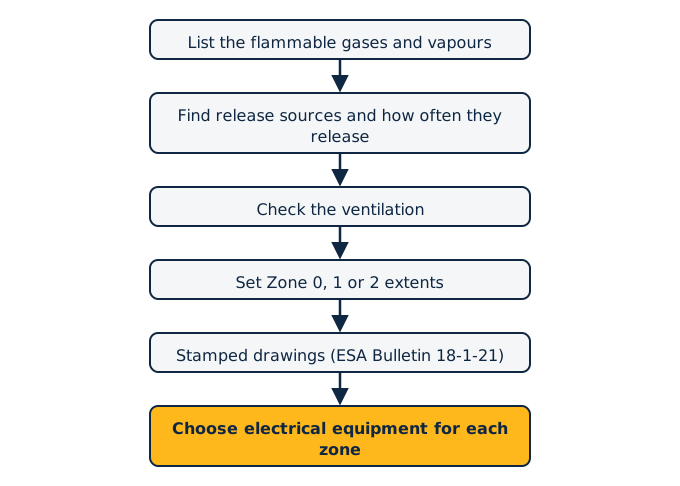
How the classification is done
- Materials. The engineer collects safety data sheets and identifies each flammable gas, vapour and liquid, with its properties.
- Release sources. Every point where material can escape is listed and graded by how often it releases: pump seals, flanges, vents, open tanks, drum filling, spray guns.
- Ventilation. Natural and mechanical ventilation are assessed, because good ventilation can shrink a zone or lower its grade.
- Zone extents. Using recognized methods such as IEC 60079-10-1, NFPA 497 and API RP 505 (all named in the PEO guideline), the engineer sets the type and size of each zone.
- Drawings and report. The zones go on scaled drawings with the basis documented, then the package is sealed.
A site visit is normal. The engineer needs to see the actual layout, ventilation and any changes since the last drawings were made.
What to have ready
- Safety data sheets for every flammable material in the area.
- Floor plans and elevations, ideally in CAD.
- Process and equipment descriptions, with quantities and operating temperatures.
- Ventilation data: fan capacities, exhaust and make-up air locations.
- Any existing classification drawings, even old Class and Division ones.
- Planned electrical work, and any gas detection you intend to use.
What drives the cost
A single room or booth is the simplest case. The fee rises with each of these:
Number of areas. Each room or area needs its own zones worked out and drawn. Several areas usually mean two site visits, and seven or more turn the job into a plant-wide study.
Facility size. A larger floor plate takes longer to walk and to draw.
Existing drawings. Current drawings that need an update cost much less than starting from nothing. Outdated drawings still give the engineer a head start.
Ventilation information. Without fan and airflow data, the engineer has to measure it or make conservative assumptions, and conservative assumptions mean bigger zones.
Timing. A deadline within a week, or a Ministry of Labour order, adds a premium. If the classification comes out of a pre-start review, the cost guide for the review itself shows what the item 1 or item 4 review adds.
| Situation | Typical engineering fee |
|---|---|
| One room, flammable vapour, GTA | $4,150 – $4,900 + HST |
| One room with current drawings to update | $3,250 – $3,800 + HST |
| Small plant, four to six areas | $12,000 – $14,000 + HST |
| One room, Sarnia area | $4,550 – $5,300 + HST |
Estimates from typical Ontario engineering fees, worked out by the same calculator as the estimator on this page (GTA unless the row names another region). They aren't quotes: the firm confirms its fee after reviewing your documents.
Timeline
A one-room job is usually a single site visit, followed by office time to analyse the release sources and produce the drawings. Larger studies take longer, and the biggest variable is how quickly you can supply SDSs, floor plans and ventilation data. Commission the classification before your electrical contractor orders equipment. Classified equipment ordered for the wrong zone is an expensive mistake to undo.
Keeping the drawings current
A classification drawing is only as good as the process it describes. Switch to a solvent with a lower flash point, add a second dispensing point, move a door or change the exhaust fan, and the zones may no longer match what's on paper. Have the engineer review the drawings whenever the materials, layout or ventilation change. Keep the sealed set somewhere maintenance staff and contractors can find it, next to the descriptive system documents for any intrinsically safe circuits. The next electrician who replaces a light fixture in that room needs to know which zone they're standing in.
Combustible dust zones
Section 18 also defines Zone 20, Zone 21 and Zone 22 for locations where explosive dust may be present, in places such as grain elevators, flour mills, feed plants and magnesium processing. Dust classification works differently from gas and vapour and isn't covered here. For dust, see this guide to hazardous location classification for combustible dust in Ontario. A collector handling that kind of dust is a separate question again, covered by the dust collector pre-start review under Item 5.
Questions people ask
Who can prepare a hazardous area classification drawing in Ontario?
ESA Bulletin 18-1-21 states that classification of hazardous locations is required to be done by a qualified, licensed professional engineer. In practice that's a P.Eng. with hazardous location experience, usually working for a firm that holds a certificate of authorization. The engineer classifies; ESA still inspects and accepts the electrical installation.
Zone or Division: which applies in Ontario?
New electrical installations in areas with explosive gases must be classified using the Zone system. Existing installations classified under the Class and Division system may keep using it for additions, modifications and renovations, following Annex J18 of Appendix J of the code. Equipment marked for Class and Division can be used in Zone locations where it corresponds to the equivalent group in Table 18A.
What does a hazardous area classification drawing show?
It shows the plan of the area with each Zone 0, Zone 1 and Zone 2 boundary marked and dimensioned, along with the release sources and materials the zones are based on. Where combustible gas detection under Rule 18-070 is used to select equipment, ESA requires the gas detection sensor locations on the stamped drawings. The drawing carries the engineer's seal.
What is Zone 0, 1 and 2?
They're the three classes of explosive gas location in Section 18, graded by how likely an explosive atmosphere is and how long it lasts. Zone 0 is where it's present continuously or for long periods, Zone 1 is where it's likely in normal operation, and Zone 2 is where it isn't likely in normal operation and, if it happens, lasts only a short time. Equipment protection requirements are strictest in Zone 0.
Is area classification part of a PSR?
Not as a separate requirement, but it often feeds one. An Item 4 ignition and explosion review, or an Item 1 review of a dispensing area, has to show ignition sources are controlled, and that usually depends on knowing the zones. If no current drawing exists, the PSR engineer may need classification done first.
Is Class I, Division 2 the same as Zone 2?
Roughly, but not exactly. Division 2 lines up with Zone 2, while Division 1 spans what the Zone system splits into Zone 0 and Zone 1, so the boundaries don't always match. For equipment, Rule 18-050 7) lets equipment marked for Class and Division be used in a Zone location when it corresponds to the equivalent group in Table 18A. The engineer's stamped drawings say which zone each area is.