
A flammable liquid storage pre-start review is required under Item 1 when a new or modified setup will hold more than 235 litres of flammable liquids in a building or room, or will dispense any. Cabinet storage that meets the Table conditions is exempt, but dispensing never is. An engineer reviews storage, ventilation, bonding and grounding before use.
Paint shops, coating lines, print plants and maintenance departments are the usual candidates, and the trigger is often smaller than people expect: a few drums of reducer staged next to a mixing bench, or one hand pump on a solvent drum. The flammable liquid storage pre-start review looks at the room as a whole: every container in it counts toward the 235 litres, whether it sits in a cabinet, on a pallet or on a bench. The cabinet exemption applies only when the storage meets all the cabinet conditions and nothing is dispensed. A typical Item 1 review runs $4,400 to $5,200 + HST.
When section 7 requires a flammable liquid storage pre-start review
Item 1 of the Table to section 7 of O. Reg. 851 has two separate triggers. The first is storage: more than 235 litres of flammable liquids located in a building or room. The second is dispensing: flammable liquids dispensed in a building, room or area. Either one is enough on its own.
The applicable provisions are subsections 22(1), (2) and (4) of the regulation. As with every Table item, the review is needed when something new is installed or a new process starts, or when an existing set-up is modified in a way that needs new or changed controls to comply. It has to be done before the set-up is used, which includes testing and commissioning. The section 7 hub page explains how that general trigger works for all eight items, and pre-start review basics in Ontario covers the rules that sit behind every review.
"Flammable liquid" has a specific meaning in section 1 of Reg. 851: a liquid with a flash point below 37.8 °C and a vapour pressure below 275 kilopascals absolute at 37.8 °C. Lacquer thinner, acetone, toluene and most solvent-based paints meet it. Your safety data sheets give the flash point, so pull them before you start counting litres.
Some situations that typically land in Item 1:
- A paint line expansion where you're adding a mixing room that will hold six or eight drums of reducer and coatings.
- A maintenance shop that outgrew its single cabinet and wants to stage drums along a wall in the same room.
- A parts-cleaning station where a drum pump fills safety cans with solvent, even if the drum itself sits in a small room.
- A plant converting a corner of the warehouse into a dedicated flammables room with racking, a spill sill and an exhaust fan (lift-truck-loaded racking there can also need an Item 3 racking review).
If you're not sure which side of the line you're on, you can check whether you need a PSR against the ministry's Item 1 flow chart before you call anyone.
Storage and dispensing are treated differently
Most Item 1 questions come down to this split. Storage has an exemption. Dispensing doesn't.
The cabinet exemption for storage
Storage above 235 litres is exempt from a pre-start review only if all three Table conditions are met. No more than 235 litres are stored per adequate cabinet. No more than three cabinets containing flammable liquids sit in a group. And there are at least 30 metres between groups of cabinets.
The ministry's Item 1 guideline chapter adds that the liquids in the cabinets must be in closed containers. It also points out that putting more than 235 litres in one cabinet is a contravention of clause 22(3)(b) in its own right. That clause describes the cabinet: double-walled metal construction, a 3-point door latch and a liquid-tight sill raised at least 50 mm above the floor. The Fire Code also sets requirements for adequate cabinets.
So four cabinets side by side, each at 200 litres, don't qualify. Neither do drums sitting next to compliant cabinets in the same room, because those drums still count toward the 235 litres located in that room.
Dispensing has no exemption
The guideline says it directly: there is no exemption for dispensing flammable liquids in a building, room or area. One drum with a hand pump is enough. If you pump, pour or transfer flammable liquid from one container to another indoors, plan on Item 1 applying and let the engineer confirm the details.
Dispensing is also where the hazard concentrates. Vapours are released every time a container is opened, and static builds up as liquid flows. That's why subsection 22(4) is aimed squarely at dispensing areas.
What the engineer checks
A pre-start review is a design review against the applicable provisions, not a general audit of your plant. For Item 1 the engineer works through subsections 22(1), (2) and (4), with the Fire Code and the other references the guideline lists in the background.
Quantities and containers
The engineer confirms which liquids meet the Reg. 851 definition, the maximum quantity that will be located in each building or room, and how it's held. Small sealed containers, cabinets, drums and totes are treated differently, and subsection 22(3) caps what can be kept in containers of 23 litres or less or in a cabinet at 235 litres.
Ventilation at dispensing points
Subsection 22(4) calls for mechanical ventilation that exhausts from floor level to the outdoors at a rate of at least 18 cubic metres per hour per square metre of floor area in the dispensing area. Solvent vapours are generally heavier than air, so a ceiling fan doesn't do the job. The engineer checks the pickup height, the discharge location and whether the fan capacity matches the floor area served. If that same exhaust is also what keeps solvent exposure under Reg. 833 limits, Item 8 applies as well; the hazardous substances ventilation review covers that side.
Bonding and grounding
The same subsection requires bonding and grounding where flammable liquids are dispensed. Expect the engineer to look at how drums, pumps, receiving containers and any piping are connected to ground, and what the procedure is to make sure workers attach the bonding clamp every time.
Ignition sources and electrical equipment
Lights, outlets, motors and forklifts near a dispensing point can ignite vapours. Where the area needs it, the engineer will point to hazardous area classification under Section 18 of the Ontario Electrical Safety Code so the electrical equipment suits the zone.
Reference documents
The guideline lists the Ontario Electrical Safety Code, Fire Code Part 4, the National Fire Code Part 4, TSSA requirements, FM guidance and NFPA 30, 68, 69 and 505 as references for Item 1. The engineer decides which ones genuinely apply to your set-up.
If the same room also holds a process that creates a risk of ignition or explosion (mixing, coating, solvent recovery), that part falls under the Item 4 ignition and explosion review. Dispensing itself stays with Item 1.
Documents to have ready
A firm can quote faster, and the engineer spends less billable time chasing information, if you gather these before the first call:
- Safety data sheets for every liquid that will be stored or dispensed, with flash points.
- An inventory of maximum quantities per building or room, by container size.
- A floor plan showing cabinet locations, drum storage, dispensing points, exits and doors.
- Manufacturer's specifications for each storage cabinet.
- Pump, nozzle and safety can details for each dispensing point.
- Exhaust fan data and ductwork layout, or the mechanical design drawings if the room is new.
- Bonding and grounding details, including clamp and grounding point locations.
- Electrical drawings for the room, and any existing area classification drawing.
- Sprinkler and fire protection information for the room.
- Your written procedures for handling, transfer and quantity limits.
Our checklist page sets out the general documents to gather before the visit for every Table item.
What drives the fee
Item 1 reviews vary with a few clear factors, and the estimator beside this page asks about each one.
How the liquids are stored. Cabinets alone are the simplest case. A dedicated storage room adds checks on separation and ventilation. Tanks bring in containment, venting and transfer piping. Detached buildings add separation-distance checks.
Total quantity. A few drums over the threshold is a modest review. Thousands of litres mean more detailed fire protection and separation work.
Dispensing method. A single drum pump is quick to assess. Pumped transfer through piping, or several dispensing points, means checking ventilation and bonding at each one.
Existing protection. Mechanical ventilation and sprinklers already in place save analysis. Without ventilation, the engineer has to show another way the vapours are controlled, or specify what to add.
Your documents and timing. Missing SDSs or drawings add research hours. A review needed within days, or against a Ministry of Labour order, costs more because the firm has to move other work.
| Situation | Typical engineering fee |
|---|---|
| Dispensing room, GTA | $4,400 – $5,200 + HST |
| Cabinets only, with dispensing | $3,500 – $4,100 + HST |
| Detached building, several dispensing points | $5,800 – $6,800 + HST |
| Tank storage, pumped transfer | $6,000 – $7,100 + HST |
| Dispensing room, Sudbury region | $4,900 – $5,800 + HST |
| Dispensing room, MOL order deadline | $5,900 – $7,000 + HST |
Estimates from typical Ontario engineering fees, worked out by the same calculator as the estimator on this page (GTA unless the row names another region). They aren't quotes: the firm confirms its fee after reviewing your documents.
For how Item 1 fees compare with the other items, read what a pre-start review costs in Ontario.
Timeline from first call to report
A straightforward Item 1 review is usually one site visit plus office time for the analysis and the written report. The calendar time depends mostly on the firm's workload and how quickly you can supply the documents above. Book the review while the room is still on paper. Changing a fan location or adding a grounding bus is cheap on a drawing and expensive after the drywall is up.
If you're already installed and running out of time, the Ministry of Labour order page covers what to do when an inspector is involved.
After the report
The report lists any measures needed to comply with the applicable provisions, or states clearly that none are needed. Typical Item 1 findings are an exhaust pickup that's too high, missing bonding at the receiving container, too many cabinets in a group or a light fixture that isn't suitable for the area.
Under subsection 7(6) you can't use the set-up until the review is done and either every measure has been taken or you've given the joint health and safety committee (or health and safety representative) written notice of what has been done to comply. A copy of the report must go to the committee or representative before start-up, under subsection 7(7). Then keep the report, with its supporting documents, readily accessible in the workplace for as long as the storage or dispensing set-up is in use.
Change the set-up later (a bigger room, a new pump, a different solvent) and you may need a fresh review. The guideline treats changing the chemicals used in a process as a modification.
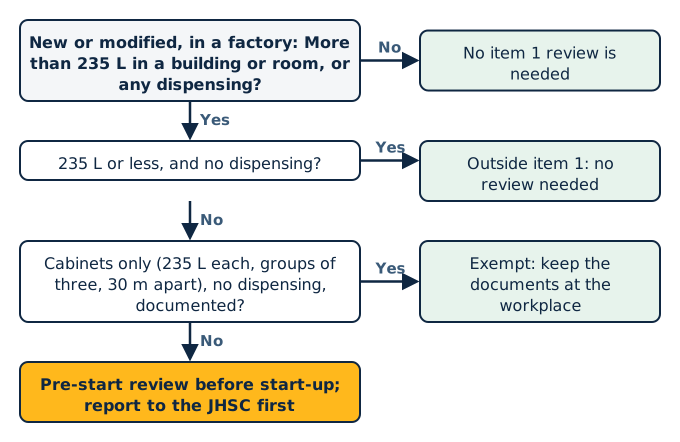
When you don't need a PSR
Small quantities and cabinet storage are the two cases where flammable liquids don't need a review, and neither one allows any dispensing. A licensed engineer can confirm an exemption from your documents for a smaller fee than a full review.
235 litres or less, and no dispensing
Item 1 applies only when more than 235 litres of flammable liquids are in a building or room, or when flammable liquids are dispensed. With 235 litres or less and no dispensing, section 7 may not apply at all.
Documents that establish it:
- An inventory of the flammable liquids and their quantities in each building or room
- Safety data sheets showing which liquids are flammable
Storage in cabinets only
Item 1 has a storage exemption when no more than 235 litres are kept per adequate cabinet, cabinets are in groups of three or fewer, and groups are at least 30 metres apart. It never covers dispensing.
Documents that establish it:
- Floor plans showing cabinet locations, groupings and the 30-metre spacing
- The cabinet manufacturer's specifications (double-walled metal, three-point latch, 50 mm sill)
- Procedures limiting each cabinet to 235 litres in closed containers
What doesn't qualify
- Dispensing flammable liquids has no exemption, whatever the quantity.
Outside item 1
- Outdoor storage away from any exit.
A mark such as CSA, ULC or CE isn't an exemption on its own. See how the other items' exemptions compare, or the ministry guideline for item 1.
Questions people ask
How much flammable liquid can I store before a PSR is needed (235 L)?
Item 1 is triggered when more than 235 litres of flammable liquids are located in a building or room. At 235 litres or less, with no dispensing, storage alone doesn't trigger a review. Count only liquids that meet the Reg. 851 definition of a flammable liquid (flash point below 37.8 °C), and count every container in that room, not just the ones in cabinets.
Is there an exemption for fire cabinets?
Yes, for storage only. You're exempt if every cabinet is an adequate cabinet holding no more than 235 litres, there are no more than three cabinets in a group, and groups are at least 30 metres apart. The liquids must be in closed containers, and you need the floor plan, cabinet specifications and a written procedure that limits quantities on file.
Does dispensing flammable liquid need a PSR?
Yes. The ministry guideline says plainly that there is no exemption for dispensing flammable liquids in a building, room or area, so quantity doesn't matter. The review looks at floor-level ventilation under s.22(4), bonding and grounding, and ignition sources around the dispensing point.
Does switching to a different solvent need a new Item 1 review?
It can. The guideline treats a change in the chemicals used in a process as a modification, and a solvent with a lower flash point or heavier vapours may need different floor-level exhaust, bonding or electrical equipment at the dispensing point. Send the new safety data sheet to the engineer who wrote the original report and ask whether the existing controls still cover it.
Does outdoor flammable storage need a PSR?
The guideline puts storage of flammable liquids outdoors and remote from any means of egress out of scope for Item 1. A storage shed or container right beside an exit door is a different case, so have the engineer confirm the location. Fire Code requirements still apply to outdoor storage either way.