
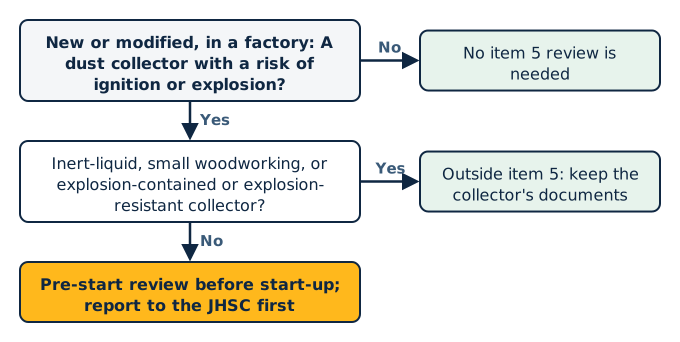
Item 5 of section 7 requires a pre-start review when a new dust collector, or a modified one that needs new controls, carries a risk of ignition or explosion. There's no exemption, but four types fall outside it: inert-liquid collectors, woodworking collectors under 0.47 m³/s not making wood flour, explosion-containing collectors, and explosion-resistant collectors vented outdoors.
Woodshops, metal finishers, and food, grain and plastics plants are where combustible dust collectors usually come up for review: a new collector goes in, an existing one moves indoors, or new machines start feeding it a different dust. A dust collector pre-start review in Ontario checks, before start-up, whether the collector's location and explosion protection meet section 65. A typical review of one outdoor collector runs $4,150 to $4,900 + HST.
When Item 5 applies
Item 5 of the Table to section 7 covers a dust collector whose use "involves a risk of ignition or explosion that creates a condition of imminent hazard to a person's health or safety." The provision the review measures against is section 65 of Reg. 851, which deals with collectors of aluminum, magnesium or other fine dust of an easily ignitable nature.
Section 65 gives such a collector two acceptable homes. It can sit outdoors. Or it can sit in a room used only to house dust-collecting equipment, where that room is separated from the rest of the building by a dust-tight partition with a fire-resistance rating of at least one hour, and is built so an explosion vents to the outdoors. The pre-start review report has to set out the measures needed to meet one of those two arrangements.
As with the other items, the trigger is change. A review is needed before a new collector starts up, and before a modified one runs again when the modification calls for new or changed controls to keep meeting section 65. Typical triggers include:
- a new baghouse, cartridge collector or cyclone serving a sanding line, a CNC router bank or a metal grinding cell;
- moving an existing collector from outside the building to an indoor location, or into a different room;
- connecting new machines that send a different, more easily ignited dust to an existing collector;
- replacing the explosion vent, the housing or the room partition with something of a different design.
The engineer has to be finished before the collector is used, and that includes commissioning runs. The duty sits with the owner, lessee or employer, so a supplier's assurance that a unit "meets code" doesn't replace the review.
What counts as easily ignitable dust
Section 65 names aluminum and magnesium, then adds "other fine dust of an easily ignitable nature" without defining it. That is narrower than "combustible dust": many dusts will burn, but section 65 speaks only of fine dust that ignites easily, and the engineer decides which side of that line yours falls on. Wood, many plastics, grain, sugar, flour and pharmaceutical powders can all ignite, but whether a particular dust at a particular fineness is "easily ignitable" is a judgment for the engineer, often based on test data or published values for that material. If the dust isn't easily ignitable, section 65 may not apply, and then Item 5 doesn't call for a review. Put that question to the engineer at the quote stage, with the safety data sheets and any test results you already have.
The four collector types outside Item 5
Subsection 65(2) switches off the location rule for four kinds of collector, and the ministry's Item 5 guideline chapter says no Item 5 review is required for them:
- Inert liquid. A collector that uses an inert liquid as the medium to collect dust, such as a properly designed wet collector.
- Small woodworking units. A collector serving a woodworking operation with a capacity under 0.47 cubic metres per second (about 1,000 CFM), as long as the operation isn't making wood flour.
- Explosion containment. A collector that will safely contain an explosion.
- Explosion resistance with venting. A collector that will resist an explosion and has effective explosion venting to the outdoors.
The guideline treats these as out of scope rather than as exemptions, and it doesn't list documents for them. The last two are engineering claims, though, so keep the manufacturer's data or an engineer's letter that supports them. How the 0.47 m³/s figure is measured, for example rated or actual airflow, or one unit or several together, isn't spelled out; ask the engineer how it applies to your setup.
There is no exemption in the Table for Item 5. A collector that doesn't fit one of the four types and handles easily ignitable dust needs the review.
What the engineer checks
The review is about whether the collector, as designed and installed, will meet section 65 and the related sections the guideline points to. The guideline lists the references a reviewer may use, including the Ontario Building Code, Fire Code and Electrical Safety Code, the Technical Standards and Safety Act, the Aluminum Association's F-1 guidelines for aluminum fines, FM Global data sheets, the ACGIH ventilation manual and NFPA 652, 654, 484 and 68.
Location and separation
For an outdoor collector, the engineer looks at where it sits relative to the building, doors, windows and walkways, and how the ducting enters. For an indoor collector, the questions are the ones section 65 asks: is the room used only for dust-collecting equipment, is the partition dust-tight, does it carry at least a one-hour fire-resistance rating, and does the room vent an explosion to the outdoors rather than into the plant.
Explosion venting
Where venting is the protection, the engineer checks that the vent discharges outdoors to a place where people won't be standing, and that the vent area suits the collector and the dust. NFPA 68, on deflagration venting, is one of the guideline's references for that calculation.
Foreign particles and separators
Section 64 of Reg. 851 isn't specific to Item 5, but the guideline flags it: where foreign particles entering equipment could set off a dust explosion, the equipment needs separators that keep them out. On a metalworking or recycling line, expect a question about tramp metal and spark sources upstream of the collector.
Questions to settle with the engineer
Some topics come up on most reviews but depend on the engineer's judgment and the standards they apply, rather than on a single rule in Reg. 851:
- whether the ducting needs isolation, such as a valve or a chemical barrier, so a collector explosion can't travel back to the machines;
- whether an existing suppression system counts toward the measures, and how it's interlocked with the fan;
- whether the dust has been tested for explosibility (for example Kst and Pmax), or whether samples need to go to a lab before the vent or isolation design can be confirmed;
- how the collector is emptied and cleaned without creating a dust cloud.
Ask early which of these the firm will cover in the review, and which it treats as separate work.
Planning the project around the review
The ministry describes a pre-start review as a design review prior to installation. For a dust collector that matters more than for most equipment, because the answer to section 65 can change the building work. Deciding between an outdoor pad and an indoor room means deciding on ducting, a wall penetration or a new rated partition, and a vent path to the outdoors. Those are expensive to change after the steel and concrete are in.
Three things help:
- Bring the engineer in when the collector is being specified, not after it's delivered. The review can then shape the location and protection rather than list changes to a finished installation.
- Ask the collector supplier for the explosion protection basis: the dust values the vent was sized for, and whether isolation is included or expected from the buyer.
- If the dust hasn't been tested, decide early whether to send samples. Waiting for lab results is the most common cause of a late report.
Documents to have ready
- The collector's manufacturer data: model, airflow, filter type, and any explosion protection fitted at the factory.
- A layout drawing showing where the collector sits, the ducting route and the machines it serves.
- For an indoor unit, drawings or specifications for the room, including the partition's fire-resistance rating and the explosion vent route to the outdoors.
- Explosion vent, isolation valve or suppression specifications, with sizing calculations if the supplier has them.
- Any dust test results for the material being collected, and safety data sheets for the materials being processed.
- For a modification, the previous pre-start review report and a marked-up drawing of what's changing.
The pre-start review document checklist covers the general items every review needs.
What drives the fee
For a single outdoor collector of 5,000 to 20,000 CFM on wood dust in the GTA, the engineering fee is typically $4,150 to $4,900 + HST. The estimator asks about the factors that move it:
- Kind of dust. Metal dusts such as aluminum bring the strictest location and protection questions; pharmaceutical and chemical dusts often need more material research.
- Size. Larger collectors have bigger vent areas and longer duct runs to assess.
- Location. An indoor collector means checking the room separation and the vent route to the outdoors as well as the unit itself.
- Explosion protection. Isolation valves and suppression systems add checks; with no protection fitted, the report has to specify what to add.
- Dust test data. If there's no test data, lab testing of samples is added as a disbursement and the report usually waits for the results.
- Number of collectors. Each extra collector needs its own review, and four or more usually take a second site visit.
| Situation | Typical engineering fee |
|---|---|
| Outdoor collector, 5,000 to 20,000 CFM, wood dust, GTA | $4,150 – $4,900 + HST |
| Indoor collector, metal dust | $5,200 – $6,100 + HST |
| Dust testing needed | $6,900 – $8,100 + HST |
| Two or three collectors | $6,300 – $7,400 + HST |
| Outdoor collector, London region | $4,550 – $5,300 + HST |
Estimates from typical Ontario engineering fees, worked out by the same calculator as the estimator on this page (GTA unless the row names another region). They aren't quotes: the firm confirms its fee after reviewing your documents.
To compare a dust collector review with the other items, see pre-start review fees across the eight items.
Timeline
A site visit is usually possible 3 to 10 business days after you engage the firm, with an extra week or two in the north. The report usually follows 5 to 10 business days after the visit. If dust samples have to go to a lab, add 1 to 2 weeks while the results come back. With a start-up date or a compliance order to meet, many firms can visit within days; the estimator prices that rush as a separate timing choice.
After the report
The report is written, signed and dated by the engineer, and sealed under the Professional Engineers Act. For Item 5, the guideline says it must include the details of the measures needed to comply with section 65. If it finds nothing more is needed, it says so. If the collector or its protection has to be tested before it goes into service, the report also sets out how workers will be protected during that testing. Before the collector runs, either every measure in the report has to be in place, or the joint health and safety committee (or the health and safety representative) has to get written notice of the measures you took instead. A copy of the report goes to the committee or representative before start-up.
Keep the report and its supporting documents at the workplace for as long as the collector is there. If you later move it, change the dust it handles, or replace the vent or room partition with something different, check whether that's a modification that needs a new review.
Other Table items that often come with a dust collector
A collector is rarely the only change. The process that makes the dust can be an Item 4 review of ignition and explosion risks in its own right. On a foundry's sand system or cleaning room, the collector sits alongside the Item 6 review of the melt shop. Where the collector's hoods are what keep workers under Reg. 833 exposure limits, the extraction is also reviewed under Item 8 for hazardous substances.
A pre-start review answers one question about one installation before it starts. If you need the wider study of every dust hazard in the facility, that's a dust hazard analysis, a separate service with its own scope.
When you don't need a PSR
Item 5 has no exemption, so the question is scope: the guideline describes collector types that item 5 doesn't cover at all. A licensed engineer can confirm from your documents that a collector is outside item 5.
Collector types outside item 5
The four types, and what each one means, are set out in the four collector types outside Item 5 above.
Documents that establish it:
- The collector's specifications (type and rated airflow)
- For explosion containment or explosion-resistant venting: the manufacturer's or an engineer's design documentation
- For woodworking collectors: the airflow rating and confirmation the shop doesn't make wood flour
A mark such as CSA, ULC or CE isn't an exemption on its own. See what each item exempts, or the ministry guideline for item 5.
Questions people ask
Does a dust collector need a PSR in Ontario?
It does when its use involves a risk of ignition or explosion and it collects aluminum, magnesium or other easily ignitable fine dust, and it's new or modified in a way that needs new controls. Item 5 has no exemption, but four collector types are outside it: inert-liquid collectors, small woodworking units under 0.47 m³/s not making wood flour, and collectors that safely contain an explosion or resist one with venting outdoors.
Is a wet dust collector exempt from a PSR?
A collector that uses an inert liquid as its collection medium is outside Item 5, so it doesn't need an Item 5 review. Check that the liquid really is inert for the dust involved, and keep the manufacturer's data on file. The process that makes the dust can still need its own review under Item 4.
Can the dust collector sit inside the building?
For a collector of aluminum, magnesium or other easily ignitable fine dust, yes, if it's in a room used only for dust-collecting equipment, with a dust-tight partition rated for at least one hour of fire resistance and explosion venting to the outdoors. Otherwise section 65 requires it to be outdoors, unless it's one of the four types the section leaves out.
Do we need dust testing before the review?
Not always. Knowing you have combustible dust isn't enough on its own; the engineer needs to know how it behaves. If its explosibility is already known from test data or reliable references, the engineer may work from that. If not, samples often go to a lab so the vent or isolation design can be confirmed, which adds a disbursement and 1 to 2 weeks. Ask the engineer at the quote stage.
Who can do a dust collector pre-start review?
Item 5 reviews must be done by an engineer, meaning someone licensed under Ontario's Professional Engineers Act. A firm offering the work to the public also needs a Certificate of Authorization from Professional Engineers Ontario.