
A performance level assessment in Ontario checks whether a machine's safety-related control functions reach the reliability their risks require, using ISO 13849-1. An engineer sets the required level for each safety function, calculates the level achieved and confirms it by validation. It supports a machine guarding review but isn't a section 7 exemption.
A performance level assessment in Ontario is usually requested by someone else: the engineer doing an Item 2 review on a robot cell, an inspector questioning a bypassed interlock, or a builder who wants a safety PLC design checked before the panel ships. The calculation follows ISO 13849-1, validation follows ISO 13849-2, and you end up with a PLr and an achieved PL for every function on the machine. Expect a typical range of $5,500 to $6,500 + HST, driven mostly by how many safety functions the machine has.
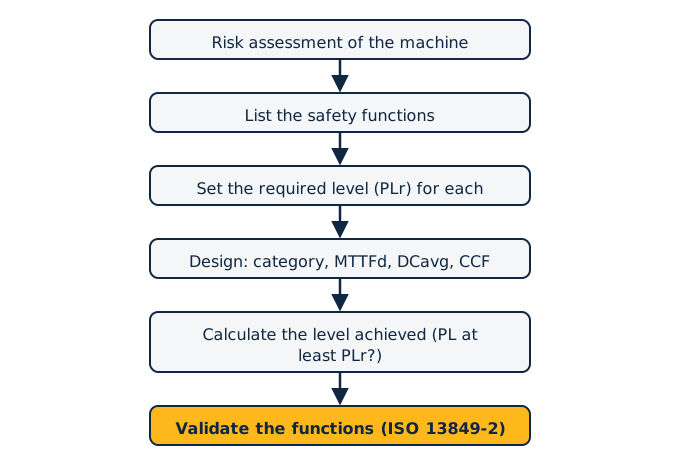
What you get from a performance level assessment
The deliverable is a report you can hand to a machine builder, a pre-start reviewer or an inspector. It shows, function by function, what reliability each safety circuit needs and whether the installed design delivers it. A complete one contains:
- a list of every safety function, written as what it does ("opening the operator gate stops the robot and prevents restart until the gate is closed and reset")
- the required performance level (PLr) for each function, with the risk graph reasoning behind it
- the architecture of each function as built: inputs, logic, outputs, and how the channels are arranged
- the verification calculation of the achieved PL, with the component data used and where it came from
- validation results: what was analysed, what was tested on the machine, and the outcome
- a list of gaps, with the changes needed where the achieved PL falls short of the PLr
The changes themselves are a separate job. So is re-verification after they're made, and so is a pre-start review of the machine as a whole.
When a PL assessment makes sense
Nothing in Reg. 851 says "do a PL assessment". It comes up because someone needs evidence that a safety circuit is good enough, and ISO 13849-1 is the common way to produce it. These are the situations where it usually lands on your desk:
- A robot cell or automated line with interlocked fencing, area scanners and a safety PLC, where the engineer doing the Item 2 pre-start review wants the circuits verified rather than assumed.
- A retrofit on older equipment, like a light curtain added to a 1990s press brake. The curtain may be rated for a high level, but the relay and valve it drives may not be. The same gap shows up in used machines bought without their schematics, where nobody knows the original design basis.
- A safety program change in a safety PLC, or a new muting sequence, where nobody can say what the original design basis was.
- An inspector's order that questions whether a guard interlock can fail to danger. The engineer answering an order from a Ministry of Labour inspector may use a PL verification as part of the testing behind a not likely to endanger report.
- A machine builder at design stage who wants component choices checked before the panel is built, when changes are cheap.
Safety functions and the required level (PLr)
Everything starts with naming the safety functions properly. A safety function is a function whose failure can immediately increase the risk, so "the light curtain" isn't one. "Interrupting the light curtain during the closing stroke stops the ram before the operator's hand reaches the die" is.
For each function, the engineer works out the PLr from the risk it reduces. ISO 13849-1 provides a risk graph built on three questions:
- Severity: would the injury be slight and normally reversible, or serious, irreversible or fatal?
- Frequency and duration of exposure: are people exposed seldom and briefly, or frequently or for long periods?
- Possibility of avoidance: could the person realistically get out of the way, or is avoidance scarcely possible?
The answers lead to a PLr from PL a to PL e. A setter reaching into a die area several times a shift, with an injury that would mean amputation and no time to react, sits at the top. A slow-moving transfer with only pinch risk sits much lower.
The PLr should come out of a risk assessment, not the other way round. ISO 12100 is the risk assessment standard most engineers use, and it's one of the standards the ministry's guideline accepts for Item 2. Many PL disputes trace back to a risk graph filled in without the risk assessment behind it.
Categories, MTTFd, DCavg and CCF
The achieved PL comes from four things working together. Get any one wrong and the number falls.
| Category | Structure | What a single fault does |
|---|---|---|
| B | Single channel, basic safety principles | Can lose the safety function |
| 1 | Single channel, well-tried components and principles | Can lose the safety function, though less likely |
| 2 | Single channel with periodic testing by the control system | Can lose the function between tests; the test should detect it |
| 3 | Two channels; a single fault doesn't lose the function | Function remains; some faults are detected |
| 4 | Two channels with high fault detection | Function remains; faults are detected in time, and accumulation of undetected faults is considered |
MTTFd
Mean time to dangerous failure, per channel, in years. It comes from component data: manufacturer figures, B10d values for electromechanical parts combined with how often they operate, or conservative defaults when no data exists. A gate switch cycled every 90 seconds wears much faster than one opened once a week, and the calculation has to reflect that.
DCavg
Average diagnostic coverage: how much of the dangerous failure rate the system detects. Cross-monitoring between two channels, feedback contacts on contactors, and valve position monitoring all raise it. A dual-channel circuit whose contactors are never monitored often has weaker coverage than people expect.
CCF
Common cause failure: one event taking out both channels at once. Think of two switches on the same bracket, both cables in one damaged conduit, or both valves fed by contaminated air. The standard scores measures against CCF (separation, diversity, environmental protection, competence), and categories 2, 3 and 4 need a minimum score.
Software matters too. If a safety PLC or configurable relay is in the chain, the standard has requirements for safety-related software, and the engineer checks how the program was specified, written and tested.
Validation under ISO 13849-2
A calculation proves the design on paper. Validation, covered by ISO 13849-2, confirms that the design actually meets its specification. It starts with a validation plan, then combines analysis (reviewing schematics against the specification, fault lists for each component, checking that faults the design claims to detect really are detected) with testing on the machine.
On site, that means things like opening each interlocked gate during each mode, pulling one wire of a dual-channel input to see whether the system faults, checking that a reset doesn't restart the machine on its own, and measuring stopping time where safety distances depend on it. Validation is where installations most often differ from drawings: a jumper left in after commissioning, a single relay where the schematic shows two, a muting sensor moved during a changeover.
How a PL assessment relates to a pre-start review
This is the point that trips people up. Item 2 of the Table to section 7 has an exemption for machines and protective elements manufactured and installed to "current applicable standards". The ministry's guideline lists the standards it accepts for that purpose, and ISO 13849-1 and -2 aren't on either of its Item 2 lists. So a PL assessment, however good, doesn't by itself establish an Item 2 exemption.
What it does well is support the review. The report required under section 7 of Reg. 851 has to list the standards, specifications, calculations and risk analyses the engineer relied on, and a PL verification of each safety circuit is exactly that kind of calculation. The PEO pre-start review guideline names ISO 13849-1 and -2 in its section on safety control system recommendations. When the engineer doing your PSR asks for PL calculations, they're asking for evidence they'd otherwise have to produce themselves.
Imported machinery raises the same question. A European declaration of conformity that cites EN ISO 13849-1 is useful design evidence, but for exemption purposes the declaration has to cite standards on the guideline's list. See the page on imported CE-marked equipment for how that plays out, and the exemption rules for each item.
A PSR, a risk assessment and a PL assessment are different documents
A risk assessment (ISO 12100, or CSA Z432 for machinery in Canada) identifies hazards and decides how to reduce them. A PL assessment checks that the control-system part of that reduction is reliable enough. A pre-start review is the legal step under Reg. 851 s.7: a review against the applicable provisions in the Table, with a report to the employer. One can feed the next, but none replaces another. On a robot cell you may well end up with all three.
What the engineer will ask for
Good inputs shorten the job and narrow the price. Gather what you can of these before the first call:
- electrical schematics, including the safety circuits, and pneumatic or hydraulic schematics where valves stop motion
- the bill of materials for safety components, with part numbers
- the safety PLC program or relay configuration files, and any safety function specification from the builder
- the machine builder's risk assessment and any PL calculations they did
- operating modes, cycle rates, and how often people open each guard or enter each zone
- for an order or incident, the inspector's wording and a description of what happened
Where component safety data is missing, the engineer has to research values or assume conservative ones, which often pushes the achieved PL down. Manufacturers usually publish B10d or PFHd figures for current safety components; older parts are harder.
What drives the fee
The number of safety functions drives it most, since each gets its own PLr and calculation. Up to three is a small job; nine to fifteen means a substantial calculation and documentation set, and beyond that it's a large verification. Several similar machines share some work, but each one is verified, and four or more usually need a second visit.
The design stage costs less site time than an existing machine because the work is on drawings and component choices. Missing component data adds research. On-site validation testing adds site time. A short deadline costs more, and a Ministry of Labour compliance date is the most expensive timing because the firm drops other work to meet it. The same timing premiums apply across pre-start review and related engineering fees.
| Situation | Typical engineering fee |
|---|---|
| One machine, 4 to 8 safety functions, GTA | $5,500 – $6,500 + HST |
| 1 to 3 safety functions | $3,500 – $4,100 + HST |
| 9 to 15 safety functions with validation testing | $8,800 – $10,300 + HST |
| Design stage, no component data | $6,900 – $8,100 + HST |
| Two or three machines | $8,000 – $9,400 + HST |
Estimates from typical Ontario engineering fees, worked out by the same calculator as the estimator on this page (GTA unless the row names another region). They aren't quotes: the firm confirms its fee after reviewing your documents.
Timeline
The site visit is usually 3 to 10 business days after you engage the firm, with an extra week or two for Northern Ontario. Calculations and the report usually follow 2 to 3 weeks after the visit. With a deadline, many firms can visit within days and issue the report shortly after. If the assessment is feeding a pre-start review, book both together so the PSR engineer isn't waiting on the PL report before start-up; a checklist for the site visit covers the rest of what to have ready.
Questions people ask
What PL does my machine need?
There's no single answer per machine, because each safety function gets its own required level. A guard interlock on a robot cell and the stop on a slow conveyor transfer can need different levels on the same line. The engineer derives each PLr from the severity of the possible injury, how often people are exposed, and whether they could realistically avoid the harm.
Is ISO 13849 required in Ontario?
Reg. 851 doesn't name ISO 13849, and the ministry's PSR guideline doesn't list it among its standards for Item 2. It's still widely used: the PEO pre-start review guideline cites ISO 13849-1 and -2 for safety control system recommendations, and many machine builders design to it. In practice it's often how an engineer shows that a safety circuit is adequate.
Is a PL assessment part of a PSR?
It can feed one, but it's a separate piece of work. A pre-start review report lists the standards, calculations and risk analyses the engineer relied on, and a PL verification is one such calculation for safety circuits. A PL assessment on its own doesn't establish an Item 2 exemption, because ISO 13849 isn't on the guideline's standards lists.
How is PLr determined (risk graph)?
ISO 13849-1 gives a risk graph with three questions: is the possible injury slight or serious, is exposure seldom or frequent, and is avoiding the hazard possible or scarcely possible. Each path through the graph ends at a required level from PL a (lowest) to PL e (highest). The engineer records the reasoning for each answer so it can be reviewed.
What is SISTEMA used for?
SISTEMA is calculation software published by Germany's Institute for Occupational Safety and Health (IFA) that models a safety function's channels and components and computes the achieved PL to ISO 13849-1. Many engineers use it, and manufacturers publish component data libraries for it. The tool does the arithmetic; the engineer is still responsible for the inputs and the architecture shown.
What's the difference between PL and SIL?
Both rate how reliable a safety function is, but they come from different standards. A Performance Level (PL a to e) comes from ISO 13849-1, and a Safety Integrity Level for machinery comes from IEC 62061. If a customer or supplier specifies one and your design uses the other, ask the engineer to map the two for each safety function rather than relying on a general conversion.