
An ignition and explosion hazard pre-start review is required under Item 4 when a new or modified process could create an imminent ignition or explosion hazard, such as solvent mixing, curing ovens or hydrogen systems. A properly built spray or paint booth is exempt, but equipment inside it, like a robot, is not. An engineer reviews the controls before start-up.
Coating plants with a spray or paint booth, ink and adhesive users, heat-treat shops and anyone adding a hydrogen or fuel-gas process are the usual clients for this work. The common thread is a flammable vapour, gas or fuel that could ignite, and the ignition and explosion hazard pre-start review checks how that risk is controlled before anyone runs the process, including during commissioning. A typical Item 4 review runs $7,200 to $8,400 + HST.
What Item 4 covers
Item 4 of the Table to section 7 of Reg. 851 applies when "a process involves a risk of ignition or explosion that creates a condition of imminent hazard to a person's health or safety." The applicable provision is section 63. It says a process that creates an explosive mixture has to be carried out either with safe, controlled burning or in an area that is isolated, adequately ventilated, free of ignition sources and fitted with explosion venting, plus baffles, chokes or dampers where they apply.
Unlike the other items, Item 4 isn't tied to a type of machine. It's tied to a hazard. That makes it the catch-all for processes that release flammable vapours or gases, or that burn fuel in a way that could go wrong. It's triggered the same way as every Table item: a new process, or a modification to an existing one that needs new or changed controls. The section 7 overview covers that general test.
The guideline is specific on scope. The review "must include the entire process, including the piping," and any appliances in the process that the TSSA hasn't reviewed. A burner the TSSA has approved drops out. The solvent supply line feeding the process next to it doesn't.
Processes that typically need an ignition and explosion hazard pre-start review
The examples below are where Item 4 most often comes up. The engineer makes the final call on whether a given process creates an imminent hazard.
Solvent processes and flammable vapours
Mixing solvent-based coatings, cleaning parts in solvent, solvent recovery, printing and laminating with flammable inks and adhesives. A new paint mixing room beside an existing booth is a common case. The booth may be exempt, but the mixing room outside it isn't covered by that exemption. Dispensing flammable liquids is reviewed separately under Item 1, flammable liquid storage and dispensing.
Ovens, dryers and curing
Curing ovens that drive off solvent from coated parts, and industrial dryers, are reviewed against NFPA 86 for purge, ventilation and safety shutoffs. A used oven bought from a plant closure, then rewired and relocated, is a typical scenario.
Fuel-fired equipment
Burners, heaters and furnaces that are part of a process. Equipment reviewed by the TSSA is out of scope, but the process it serves and any non-TSSA-reviewed pieces stay in. CSA B149.1 is the gas installation code the guideline references, though it cites the 2005 edition, which is well out of date. In a foundry, the melt shop layout around a furnace also needs an Item 6 foundry review.
Hydrogen and other flammable gases
Processes that use or generate hydrogen or other flammable gases need attention to gas detection, ventilation and where a release could collect. These reviews take more specialised analysis than a typical solvent process.
Battery manufacturing and energy storage
The guideline doesn't name battery plants or energy storage systems. Item 4 turns on section 63 of Reg. 851: a process likely to produce a gas, vapour, dust or fume capable of forming an explosive mixture with air. Ask the engineer whether that describes your process, for example electrode coating and drying with flammable solvents, electrolyte handling, or a battery room or storage system that could release flammable gas. If it does, the guideline says the review covers the entire process, including the piping. Large solvent quantities may also bring in Item 1 for storage and dispensing.
Dip tanks
There is no separate Table item for dip tanks. A dip tank using flammable or combustible liquids falls under Item 4 if the process creates an ignition or explosion risk. The guideline lists NFPA 34 as a reference for dipping and coating, but it isn't one of the asterisked standards, so building a tank to NFPA 34 doesn't create an exemption.
Combustible dust
Processes that handle combustible dust can also fall under Item 4, and dust collectors have their own item (see the dust collector PSR page). If you need a full study of your dust hazards rather than a pre-start review, a dust hazard analysis is the right starting point.
Spray booths and paint booths: the exemption and its limits
Item 4 has one exemption: the process is conducted inside a spray booth that has been manufactured and installed in accordance with current applicable standards. The Item 4 guideline chapter names NFPA 33 as an accepted standard and adds that the Building Code and Fire Code must also be met.
Three things have to be true. The booth must be manufactured and installed to current applicable standards. It must meet the Fire Code definition of a spray booth, which is "a power-ventilated structure that encloses or accommodates a spraying operation so that spray vapour and residue can be controlled and exhausted." That can include a self-contained powder coating unit. And you need the documents: written confirmation from the manufacturer, or certification from an accredited organization, that the booth meets current applicable standards, plus a written statement from the installer that it was installed to them.
This is the limit that catches people. The guideline says, in bold, that "the exemption for spray booths does not apply to equipment installed inside the spray booth (for examples, robots)." Put a painting robot in a compliant paint booth and the robot, its controls and anything else added inside still need review. A robot cell going in over a long weekend at a coating plant is exactly where this gets missed.
If the integrator can't show how reliable the robot's safety circuits are, the engineer may ask for a PL assessment to ISO 13849-1.
Note that the guideline's accepted standards list names specific editions. Don't assume a booth built to the newest edition of a standard automatically meets the exemption; the reviewing engineer decides that.
What the engineer checks
The review follows section 63 and the reference standards the guideline lists for Item 4: NFPA 30, 33, 34, 68, 69, 86, 497, 499, 505 and 820, CSA B51 and B52, CSA B149.1, the ACGIH Industrial Ventilation manual, API 500, and the Ontario Electrical Safety Code, Fire Code, National Fire Code and Building Code. Only the ones that fit your process will matter.
In practice the engineer works through these questions for each area:
- What flammable materials are present, in what quantities, and where they can be released.
- Whether ventilation keeps concentrations safely low, and what happens if the fan stops.
- Where ignition sources are, including electrical equipment, hot surfaces and static.
- Whether the area is isolated from the rest of the plant, and how explosion venting, baffles, chokes or dampers are arranged where they apply.
- Whether interlocks, purges and shutoffs on ovens and burners do what the standard requires.
- How workers will be protected during testing and commissioning.
Electrical equipment selection usually depends on the hazardous area classification of the space. If you have a current classification drawing, the engineer starts from it. If it's outdated or missing, establishing the zones becomes part of the job. Ventilation that also keeps workers below Reg. 833 exposure limits for the same solvent is a separate question under Item 8, covered in the ventilation PSR for hazardous substances.
Documents to gather first
- Safety data sheets for every flammable material in the process.
- Process description, flow diagram and maximum quantities in each area.
- Layout drawings showing the equipment, rooms, doors and adjacent areas.
- Ventilation design or fan data, including make-up air.
- Electrical drawings and any existing area classification drawings.
- Manufacturer manuals for ovens, burners, booths and controls.
- TSSA approvals for any appliances, so they can be scoped out.
- Booth manufacturer and installer documents, if you're relying on the spray booth exemption.
Add the general items from the pre-start review checklist, which apply to every review.
Cost drivers for an Item 4 review
Item 4 reviews range more widely than most items because the processes vary so much. The main drivers:
Type of process. A single solvent process is the baseline. Ovens and fuel-fired equipment add burner safety and NFPA 86 checks. Hydrogen and battery systems need specialised gas detection and ventilation analysis. A spray booth that doesn't qualify for the exemption is reviewed with everything installed in it.
Number of areas. Each room or zone gets its own hazard and control review. Four or more areas usually means a second site visit.
State of your area classification. Current drawings save analysis time. Outdated drawings have to be checked and corrected. No drawings at all means the zones have to be worked out first, which is often the biggest single addition.
Information and timing. Missing SDSs mean research hours. A rush job, or a Ministry of Labour order deadline, raises the fee.
| Situation | Typical engineering fee |
|---|---|
| Solvent mixing room, GTA | $7,200 – $8,400 + HST |
| Coating outside a spray booth | $7,600 – $8,900 + HST |
| Curing ovens | $7,800 – $9,200 + HST |
| Hydrogen or battery system | $8,900 – $10,400 + HST |
| Two or three areas, no classification drawings | $11,300 – $13,300 + HST |
| Solvent room, needed within a week | $8,600 – $10,100 + HST |
Estimates from typical Ontario engineering fees, worked out by the same calculator as the estimator on this page (GTA unless the row names another region). They aren't quotes: the firm confirms its fee after reviewing your documents.
For travel, rush and exemption-review figures on the same basis, see what other pre-start reviews cost.
Timeline
Plan for at least one site visit, then analysis and report writing at the office. Multi-area processes and plants without classification drawings take longer. The cleanest approach is to involve the engineer at the design stage, before equipment is ordered. Moving a fan, changing a motor enclosure or relocating a light is easy on paper and costly once installed.
After the report
The sealed report lists the measures needed to comply with section 63, or says clearly that none are needed. Common findings include ventilation interlocks that don't stop the process when the fan fails, electrical equipment that doesn't suit the zone and missing explosion venting on an oven.
Before start-up, the measures must be in place, or the joint health and safety committee or health and safety representative must get written notice of what has been done to comply. A copy of the report goes to them before the process runs. Keep the report and its supporting documents readily accessible for as long as the process is used. If you later change the materials or the process, check whether a new review is needed; the guideline counts changing the chemicals used in a process as a modification.
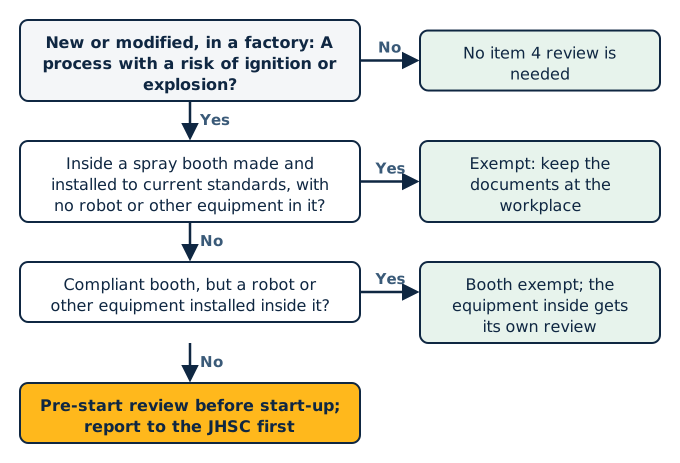
When you don't need a PSR
The spray booth is the only exemption under item 4, and it covers the booth alone: a robot or other equipment installed inside it still gets reviewed. A licensed engineer can confirm an exemption from your documents for a smaller fee than a full review.
Spray booth made and installed to current standards, with nothing inside
Item 4 doesn't require a review for a process inside a spray booth that was manufactured and installed to current applicable standards, and you've said nothing is installed inside it.
Documents that establish it:
- The manufacturer's declaration, or certification from an accredited body, naming the standards the booth meets (for example NFPA 33)
- The installer's written statement that it was installed to those standards and the manufacturer's instructions
- A note confirming that no robot or other equipment is installed inside the booth
Spray booth with a robot or other equipment inside
Item 4 exempts a process inside a spray booth made and installed to current applicable standards, but not equipment installed inside the booth. A robot or other equipment in the booth is reviewed on its own: its safeguarding (item 2) and whether it adds an ignition source (item 4).
Documents that establish it:
- The manufacturer's declaration, or certification from an accredited body, naming the standards the booth meets (for example NFPA 33)
- The installer's written statement that it was installed to those standards and the manufacturer's instructions
- The robot or equipment manual, including any hazardous-location rating
- Layout drawings showing the equipment inside the booth and its safeguarding
What doesn't qualify
- Equipment installed inside the spray booth, such as a robot, isn't covered by the booth exemption.
Outside item 4
- Dispensing flammable liquids, which is item 1.
- Appliances reviewed by the Technical Standards and Safety Authority (TSSA).
A mark such as CSA, ULC or CE isn't an exemption on its own. See exemptions under the other Table items, or the ministry guideline for item 4.
Questions people ask
What is an Item 4 PSR (process with risk of ignition or explosion)?
It's the pre-start review for the fourth item in the Table to section 7 of Reg. 851: a process that involves a risk of ignition or explosion creating a condition of imminent hazard to a person's health or safety. The engineer reviews the process against section 63, which deals with isolation, ventilation, ignition sources and explosion venting. The review has to cover the entire process, including the piping.
Are TSSA-reviewed appliances excluded?
Yes. The ministry guideline lists appliances, boilers and pressure vessels, and propane-fired equipment reviewed by the TSSA as out of scope for Item 4. Any appliance in the process that the TSSA hasn't reviewed stays inside the PSR scope. Keep the TSSA approval paperwork with your records.
Does a spray booth exemption apply?
It applies when the process is conducted inside a spray booth that was manufactured and installed to current applicable standards, including NFPA 33, and the booth meets the Fire Code definition of a spray booth. You need the manufacturer's or an accredited body's declaration plus the installer's written statement. Equipment installed inside the booth, such as a painting robot, is not covered by the exemption.
Does a dip tank need an Item 4 PSR?
It does when the tank holds flammable or combustible liquids and the dipping process creates a risk of ignition or explosion. There's no separate Table item for dip tanks, so they're reviewed under Item 4. The guideline lists NFPA 34 as a reference, but building a tank to it doesn't give you an exemption.
Does an Item 4 PSR need hazardous area classification?
Often, yes in practice. The engineer has to show that ignition sources are controlled, and that usually depends on knowing where flammable atmospheres can exist. If you don't have a current area classification drawing, the engineer may need to establish the zones first, which adds time and cost.