
A foundry pre-start review is required under Item 6 when an Ontario factory installs a process that produces aluminum or steel or melts or handles molten material, or modifies one so that it needs new controls. There is no exemption. An engineer reviews the workplace around the furnaces, ladles and pouring areas against sections 87.3 to 102 of Reg. 851.
Iron, steel and aluminum foundries, primary aluminum and steel producers, and shops pouring non-ferrous metal into sand or investment moulds are the plants this applies to. Most reviews come from capital projects: a second induction furnace, a cupola rebuild, a new pouring line or a gallery where ladles will be handled. The foundry pre-start review looks at the floor, aisles, pits and exits around the melt, not inside the furnace.
A typical single-furnace review runs $12,900 to $15,200 + HST. Cupolas, steel production and multiple furnaces push it higher.
Which plants fall under Item 6
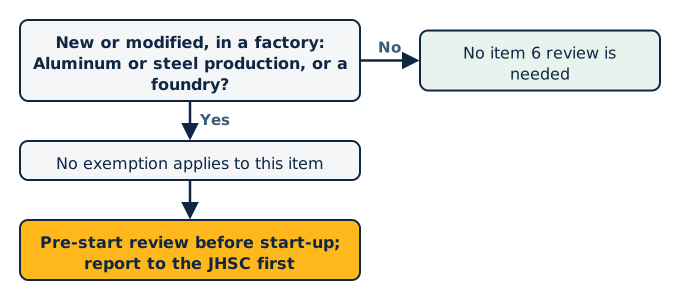
Item 6 of the Table to section 7 of Reg. 851 applies when "a factory produces aluminum or steel or is a foundry that melts material or handles molten material." That's two separate routes in. A steel mini-mill or an aluminum producer is caught by the first. A jobbing sand foundry pouring grey iron is caught by the second.
The word foundry has a defined meaning in section 1 of Reg. 851. It's the part of a building or premises where base metals or their alloys are cast in moulds, other than permanent moulds, along with core-making, shakeout, cleaning and other dust-causing work tied to the casting process. Sand casting and investment casting fit. A pure permanent-mould or die-casting operation may not, unless it also produces aluminum or steel. The guideline doesn't rule on that case directly, so treat it as a question for the engineer rather than an answer you can rely on.
Even where the foundry definition doesn't fit, sections 88 to 102 of Reg. 851 still apply to a broad range of workplaces that use molten metal. Falling outside Item 6 removes the PSR, not the rules about how the floor around a melting unit has to be set up.
When a foundry pre-start review is required
Section 7(2) triggers the review for anything new, or for a modification that needs new or changed controls to meet the applicable provisions. In a foundry, most capital projects qualify. Some examples:
- A second induction furnace goes in next to the first, sharing the same pouring aisle.
- A cupola is being rebuilt with a closed top and a new charging arrangement.
- Pouring moves from hand shank ladles to a crane-carried bottom-pour ladle, which changes the aisle widths the regulation requires.
- A new mezzanine or gallery is built where ladles will be handled above a working area.
- A pit is dug for a new moulding line and will be more than 60 centimetres deep.
Changing the metal or alloy you pour, or the size of your ladles, can also count as a modification. The guideline defines modification broadly enough to include replacing a part with a non-identical one.
No exemption for Item 6
Item 6 has none. The Table says "None", and the ministry guideline repeats that there are no exemptions for Item 6. A furnace built to a recognized standard, a supplier's declaration, or a previous review at your sister plant doesn't remove the need for a PSR. If you're unsure whether your project is a new installation or a modification, the ministry's flow chart shows when a pre-start review is required.
What the review covers around the melting unit
The guideline is specific: an Item 6 PSR doesn't need to include a review of the melting unit itself, because the applicable sections deal with the physical set-up of the workplace as a whole and around the melting unit. The engineer looks at the space, not the furnace's internal design.
These are the applicable provisions and what each one asks for:
| Section | What it requires |
|---|---|
| 87.3 | Engineering controls, to the fullest extent reasonably possible, to prevent spillage of molten material, backed by other measures and procedures where controls alone can't prevent it |
| 87.4 | Adequate means of egress from every location where workers may be exposed to molten material |
| 87.5 | For runout, pouring or moulding pits more than 60 cm deep (or walled above 60 cm) built or altered after May 1, 1995: non-combustible, slip-resistant doorways, ramps or stairs; two exits, well separated, for pits over 15 square metres or with any point more than 5 metres from an exit; an exit within 25 metres of any point |
| 88 | Clear space around any cupola or melting unit; passageways beside it at least 1.2 metres wide; firing and fuel controls reachable from an aisle or a remote location; working space at least 1.8 metres from the shell or spout (with an exception for units installed before July 31, 1964) |
| 90(1) to (3) | Minimum gangway widths where molten metal is conveyed, which depend on the container and the number of workers carrying it |
| 91 and 92 | Minimum pouring aisle widths for hand shank ladles and crucibles, and for crane, trolley or truck ladles |
| 94 | Tilting ladles secured against accidental overturning |
| 95 and 96 | Cupola protection, explosion venting on closed tops, gas accumulation controls, and the props and warning procedure for dropping the bottom |
| 99 | A shield of wood planking at least 38 mm thick where castings or scrap are broken with a dropping device |
| 101 | Floors and water systems around a melting unit built so moisture can't collect under or near it |
| 102 | Where molten metal is handled on a gallery or mezzanine above a working space, a solid floor it can't burn through and a solid barrier at least 1.05 metres high on exposed sides |
Give section 101 real attention. Water trapped under or near molten metal can turn to steam violently, and the engineer will want to see floor drains, cooling water lines and anything else that could put moisture near the furnace or the pouring area.
The report sets out the measures needed for compliance with each provision, or states clearly that none are needed. If the furnace will be fired or test-poured before start-up, it must also describe how workers will be protected during that testing.
Other Table items that often come with a foundry project
An Item 6 review doesn't cover everything in the building. A new overhead crane carrying ladles falls under Item 7 for lifting devices, and needs its own structural review unless the runway was originally designed for it. Fume capture over the melt deck that's there to keep workers under Reg. 833 exposure limits points to Item 8, ventilation for hazardous substances. A dust collector on the sand system or the cleaning room may need a look under Item 5 for dust collectors, and gas-fired equipment with an explosion risk under Item 4. Die-casting cells with interlocked guards bring in Item 2, machine safeguarding.
If you store or pump alcohol-based core coatings or mould washes, check them against Item 1 for flammable liquids too. One engineering firm can usually cover several items in one report, with each engineer signing for their discipline. That can save a second site visit.
Documents to have ready
- A scaled floor plan showing the melting units, pouring aisles, gangways, pits and exits
- Furnace or cupola data: type, capacity, location of firing and fuel controls
- Ladle types and sizes, how metal moves from furnace to mould, and how many workers do it
- Floor construction, drains and the routing of cooling water near the melting area
- Drawings of any mezzanine or gallery where molten metal will be handled
- Your current spillage procedures and the PPE you use
- For a modification, the previous PSR report, if one exists
Use the preparation checklist for everything else.
What drives the fee
Foundry reviews are among the larger PSRs, because the engineer has to walk every route molten metal takes. The biggest factors are the process and how much of it changes.
A cupola adds charging, emissions and tapping hazards to review. Steel production involves larger furnaces and more molten metal handling. Die-casting usually adds safeguarding work at the casting cells. Each additional furnace adds its own review, and four or more usually take an extra site visit.
How metal is moved matters too. Cranes moving ladles get reviewed for the lifting and spill hazards together, and automated pouring adds control-system and guarding checks. A modification to an existing foundry means comparing the old and new arrangements, and missing drawings add desk time.
| Situation | Typical engineering fee |
|---|---|
| Induction furnace with ladles and cranes, GTA | $12,900 – $15,200 + HST |
| Die casting (where Item 6 applies) | $13,400 – $15,700 + HST |
| Steel production, two or three furnaces | $21,600 – $25,300 + HST |
| Changes to an existing foundry | $13,900 – $16,300 + HST |
| Induction furnace, Hamilton | $13,400 – $15,800 + HST |
Estimates from typical Ontario engineering fees, worked out by the same calculator as the estimator on this page (GTA unless the row names another region). They aren't quotes: the firm confirms its fee after reviewing your documents.
Foundries are the largest pre-start reviews in the Table; see how foundry fees compare with other reviews.
Timing is the last factor. A review needed within a week costs more, and one needed to meet a compliance deadline in a ministry order costs the most.
Timeline
Bring the engineer in at layout stage. Aisle widths and pit exits are cheap to change on a drawing and expensive to change once concrete is poured and the furnace is set. The guideline describes the PSR as a design review before installation, so a review of the plans, followed by a site visit before first melt, is the normal pattern.
After the report
Under section 7(6), the melting set-up can't be operated until the measures the report calls for are in place, or the joint health and safety committee or health and safety representative has written notice of the measures actually taken. A copy of the report goes to them before the first melt. Then keep the report and its supporting documents readily accessible for as long as the set-up stays in use; an inspector can ask for them at any time. If an inspector later questions a ladle crane or a gallery floor, the order may call for testing and a sealed engineer's statement that the equipment is not likely to endanger a worker, which is separate from this review.
The guide to section 7 and its Table explains how Item 6 sits alongside the other seven items.
Is there any way around an Item 6 review?
There is no exemption under item 6: a new or modified melting, pouring or molten-metal handling process always needs a review before start-up.
What the item 6 review covers
- The review covers how the workplace is set up around the melting unit, not a design review of the melting unit itself.
A mark such as CSA, ULC or CE isn't an exemption on its own. See the items that do have exemptions, or the ministry guideline for item 6.
Questions people ask
Are there exemptions for foundry PSRs?
No. The Table to section 7 lists no exemption for Item 6, and the ministry guideline repeats that there are no exemptions. Equipment certification, a CE mark or a previous review at another plant doesn't change that. If the circumstance exists and the work is new or a qualifying modification, a PSR is required.
Does an Item 6 PSR cover the melting furnace?
Not the furnace itself. The guideline says an Item 6 PSR doesn't need to review the melting unit, because the applicable sections deal with the physical set-up of the workplace as a whole and around the melting unit. The engineer looks at clearances, aisles, egress, spillage controls, the floor and nearby water systems.
Which Reg 851 sections does a foundry PSR check?
Sections 87.3, 87.4, 87.5 and 88, subsections 90(1), (2) and (3), and sections 91, 92, 94, 95, 96, 99, 101 and 102. They cover spillage prevention, egress, pits, clearances around melting units, gangway and pouring aisle widths, tilting ladles, cupolas, scrap breaking, moisture control and molten metal on mezzanines.
Does a die-casting shop count as a foundry?
Possibly not. Reg. 851 defines a foundry as a place where metals are cast in moulds other than permanent moulds, and die-casting uses permanent dies. A die-caster that doesn't produce aluminum or steel may fall outside Item 6, but that's a judgment for the engineer, and the molten metal sections still apply to the workplace.
Does a new furnace in an existing foundry need a PSR?
Yes, in almost every case. A new melting unit changes clearances, aisles, egress routes and spillage paths, so the set-up around it has to be reviewed. Replacing a furnace with an identical one in the same spot, with nothing else changing, is closer to maintenance, so ask the engineer to confirm.