
A Ministry of Labour compliance order in Ontario is an inspector's written direction to fix a contravention by a set date. Read what it requires, note the date and post the order. If it asks for an engineer's report under section 54(1)(k), engage a professional engineer early. Appeals go to the Ontario Labour Relations Board within 30 days.
On equipment, a Ministry of Labour compliance order in Ontario often cites machine guarding under section 25 of Reg. 851 or a missing pre-start review under section 7, and some add a demand for an engineer's sealed test report. The painful ones carry a stop-use line on a production machine, where every day spent waiting for a firm costs output. Where an engineer's report is required, it typically runs $3,700 to $4,350 + HST, and the order's own wording decides how much of the fix your maintenance team can handle without outside help.
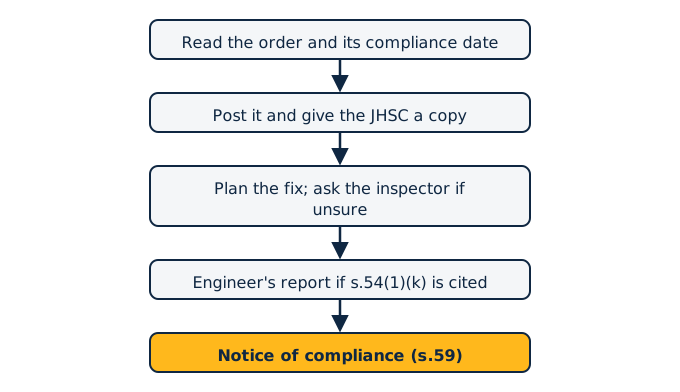
The first 48 hours, in order
An order feels urgent because it is. But the inspector has already decided what has to happen and by when, and the clock rewards a clear plan more than a fast one. Work through these steps before you call anyone outside the plant.
- Post it and share it. OHSA s.57(10) says you must post a copy of a written order where workers are most likely to see it, and give a copy to the joint health and safety committee and the health and safety representative, if you have them. Do this today.
- Stop what the order stops. If the order says a machine, process or area can't be used until you comply, lock it out and tag it. Don't remove a notice the inspector fixed to the equipment; s.57(9) reserves that for the inspector.
- List every item separately. One visit can produce several numbered orders. Write each one on its own line with the provision cited, the location and the compliance date.
- Sort the items by who fixes them. Some your maintenance team can close this week. Others name an engineer, a report or a pre-start review, and those set your critical path.
- Book the engineering work. Send the order, photos and equipment documents to a firm on day one. Engineers' calendars, not your repair crew, usually decide whether the date is achievable.
- Tell your JHSC worker member what's planned. You'll need their statement on the notice of compliance later, so bring them in early.
Reading the order
Section 57(1) of the Occupational Health and Safety Act gives an inspector who finds a contravention the power to order you to comply, either "forthwith" or within a period the inspector specifies. An oral order has to be confirmed in writing before the inspector leaves (s.57(2)). The inspector doesn't have to give you a hearing first (s.57(11)).
The written order must indicate generally the nature of the contravention and, where appropriate, its location (s.57(3)). That's often brief. "Reg. 851, s.25, guarding" on a press brake tells you what the inspector saw but not how to fix it. Match each citation to the regulation text on e-Laws so you know exactly which requirement you're answering.
Things to look for on the page
- The compliance date. "Forthwith" means now. A date means that date, not the end of that week.
- A stop-use or stop-work line. Under s.57(6), when a contravention is a danger to a worker, the inspector can order that a machine or process not be used until you comply, stop work, or have an area cleared and barricaded.
- A compliance plan. Section 57(4) allows the order to require a written plan saying what you'll do and when. If yours does, that plan has its own deadline.
- A reference to s.54(1)(k) or (l). That's the engineer's testing and report requirement, explained below.
- A reference to section 7 of Reg. 851. That points to a missing pre-start review, which is a different fix: a new pallet rack loaded before its rack review was done, say, or a solvent dispensing station set up without an Item 1 flammable liquids review.
What section 54(1)(k) asks for
Clause 54(1)(k) allows an inspector to "require in writing an employer to have equipment, machinery or devices tested, at the expense of the employer, by an engineer and to provide, at the expense of the employer, a report bearing the seal and signature of the engineer stating that the equipment, machine or device is not likely to endanger a worker."
Clause (l) goes with it: the inspector can require in writing that the equipment not be used pending that testing. Clause (j) allows the inspector to require that equipment be operated or a procedure carried out for an examination or test. So a typical sequence on a hoist with a cracked trolley weld is a stop-use requirement, then testing by an engineer, then the sealed report, then the inspector's decision.
The report isn't a general opinion about your plant. It answers one question about specific equipment, and the engineer can only sign it once the testing supports that answer. The not likely to endanger engineer's report page covers what the testing involves (functional checks, load tests, non-destructive testing) and what the report contains.
Who can write the engineer's report
The Act defines "engineer" as a person licensed as a professional engineer, or holding a limited licence, under the Professional Engineers Act. A technician's inspection sheet, a supplier's service letter or an out-of-province engineer without an Ontario licence won't meet the order.
Two more practical filters matter. A firm offering engineering services to the public needs a certificate of authorization from Professional Engineers Ontario (Professional Engineers Act s.12(2)). And the engineer's discipline should fit the equipment: a structural engineer for a crane runway, someone who works with safety circuits for an interlocked guard on a robot cell. If the order turns on how reliable a safety circuit is, the engineer may run a performance level assessment as part of the testing.
Some orders use clause 54(1)(f) instead, which allows the inspector to specify testing by a person with special expert or professional knowledge or qualifications. Read the wording closely; if it names a qualification other than an engineer, that's who you need.
When a pre-start review is the right response instead
Sometimes the inspector's real finding is that new or modified equipment went into service without a pre-start health and safety review. A used press brake bought at auction and wired in with a light curtain is a classic case of a skipped Item 2 machine guarding review. Section 7 of Reg. 851 required a review (or a documented Table exemption) before it ran, and an engineer's "not likely to endanger" report doesn't replace that. Imported machines get caught the same way, because a CE mark doesn't satisfy section 7 on its own; see CE-marked equipment brought into Ontario.
The ministry's guideline is direct about it: if equipment was installed without a review, a review must still be completed or an exemption documented before it's operated. The report then goes to the JHSC or representative before start-up (s.7(7)). See how section 7 and its eight items work, and find out if you need a review if you're not sure the Table applies.
| Question | s.54(1)(k) report | Pre-start review |
|---|---|---|
| What starts it | An inspector's written requirement | Your own change: new equipment, or a modification that needs new or changed controls, under a Table item |
| Question answered | Is this equipment not likely to endanger a worker? | What measures are needed to comply with the applicable provisions in the Table? |
| Who does it | An engineer | An engineer for items 1 to 7; for item 8, a professional engineer or another qualified person, such as a certified industrial hygienist |
| When | By the date in the order | Before the equipment is operated or used, including testing and commissioning |
| Testing | Always (that's the point of the clause) | Only if needed; the report then sets out how workers are protected during testing |
Orders can ask for both. If a modified robot cell is cited under section 7 and its gate interlock is also under a s.54(1)(k) requirement, one firm can often scope both jobs together. Check the exemption rules for each item first; with the right documents, the review may not be needed at all.
Briefing a firm so it can quote today
Firms answering urgent orders triage by how complete your first email is. Send these together:
- a scan of the full order, every page, including the compliance date
- photos of the equipment, its nameplate and the specific area the inspector cited
- manuals, electrical drawings, and any earlier engineer's reports or PSRs for the equipment
- a note on what's already been done since the visit, and whether the equipment is tagged out
- site address, access hours and a contact who can be on the floor during the visit
Most of the document checklist applies here too, since it lists what engineers ask for by equipment type.
What drives the fee
The equipment sets the base. A single machine with a guarding question is the lighter end. A crane, hoist or lifting device brings structural and load checks, and a platform or structure needs a structural assessment. Testing adds cost: a load test needs test weights and extra site time, and non-destructive testing is done by a testing company and billed to you as a disbursement.
The compliance date matters a lot. A date within a week is the most expensive timing because the firm rearranges other work, and one to two weeks usually still means rush scheduling. Missing manuals or drawings add desk time, since the engineer has to work out from the equipment itself what the documents would have said.
What closing an order usually costs
Most orders on equipment end in one of two ways: an engineer's report the order asks for, or the pre-start review that should have been done before start-up, now on the inspector's timetable. The deadline is what pushes these fees above a normal booking.
| Situation | Typical fee |
|---|---|
| Section 54(1)(k) report, one machine (1 to 2 weeks to comply) | $4,650 – $5,400 |
| Crane report with a load test (1 to 2 weeks to comply) | $9,100 – $10,700 |
| Missed machine guarding PSR (MOL deadline) | $5,200 – $6,100 |
| Missed racking PSR (MOL deadline) | $5,400 – $6,400 |
| Missed flammable liquids PSR (MOL deadline) | $5,900 – $7,000 |
Engineering fees before HST, worked out by the same calculator as the estimator, GTA and full documentation, at the compliance timing shown in each row.
If you can't meet the compliance date
Call the inspector before the date, not after. Explain what's booked, when the engineer can test, and what's holding things up, then follow the call with an email so there's a written record. Don't assume the date has moved until the inspector tells you it has. If you don't have the inspector's direct number, the ministry's Health and Safety Contact Centre is at 1-877-202-0008.
Appeals are a separate route. Under OHSA s.61, an employer who considers itself aggrieved by an order may appeal to the Ontario Labour Relations Board within 30 days after the order was made. The Board may suspend the order while the appeal runs, but an appeal doesn't suspend it automatically. Most equipment orders are faster to comply with than to contest, and that's a decision for you and your legal adviser.
Closing the order out
Within three days after you believe you've complied with an order made under s.57, you must send the Ministry a notice of compliance (s.59(1)). You sign it, and it's accompanied by a statement from a worker member of the committee or the health and safety representative agreeing or disagreeing with it, or a statement that they declined to sign. Post the notice and the order for 14 days.
Attach the sealed engineer's report or the PSR report where the order called for one. Keep in mind that s.59(4) says compliance is achieved when an inspector determines it has been, so the notice starts that step rather than finishing it. File everything with the equipment's records; if the work involved a pre-start review, section 7(8) requires the report to stay readily accessible in the workplace for as long as the equipment does.
Questions people ask
What do I do after a Ministry of Labour order on a machine?
Post the order where workers will see it and give a copy to your joint health and safety committee or representative, which OHSA s.57(10) requires. Lock out the machine if the order says it can't be used. Then identify each provision cited, note the compliance date, and if the order asks for an engineer's report, send the order and the machine's documents to an engineering firm the same day.
Do I need an engineer to comply with an MOL order?
Only if the order calls for one. An order under s.54(1)(k) requires testing by an engineer and a report bearing the engineer's seal and signature, and an order citing section 7 of Reg. 851 usually means a pre-start review, which an engineer conducts for Table items 1 to 7. Plenty of orders (a missing fixed guard, a blocked exit) can be fixed by your own maintenance staff.
How do I appeal a Ministry of Labour order?
Under OHSA s.61, an employer, owner, worker or trade union that considers itself aggrieved by an inspector's order may appeal to the Ontario Labour Relations Board within 30 days after the order was made. Filing an appeal doesn't pause the order by itself: the Board may suspend it while the appeal is decided, but it doesn't have to. Get legal advice before you rely on an appeal instead of complying.
What is a notice of compliance?
It's the form you send the Ministry within three days after you believe you've complied with an order made under OHSA s.57. You sign it, and it goes with a statement from a worker member of the committee (or the health and safety representative) agreeing or disagreeing, or noting that they declined to sign. You post the notice and the order for 14 days after sending it.
How long do I have to comply with an MOL order?
As long as the order says. Section 57(1) allows the inspector to require compliance immediately ("forthwith") or within a period the inspector specifies, so the date on your order is the deadline. If an engineer's testing or parts lead times make that date unrealistic, call the inspector before it passes rather than after.