
A pre-start review is required in Ontario when, in a factory, new or modified equipment, structures, protective elements or processes will create one of the eight circumstances in the section 7 Table, and that item's exemption doesn't apply with documents to prove it. Logging operations are exempt. The checker below follows the official flow charts.
The question of when a pre-start review is required in Ontario usually comes up at the purchase order: a used press brake from an auction, a new rack line for a warehouse expansion, a vehicle hoist for a fleet shop. The owner, lessee or employer makes the call, and the person applying the test doesn't have to be an engineer. Most wrong answers come from assuming a CE or CSA mark is an exemption, or from relying on an exemption without the paperwork in the building.
Answer the checker's questions for one change at a time: one machine, one rack line, one new process. It asks the same questions as the cost estimator's exemption screening, so if it says you need a review, you'll recognise the questions when you use the estimator beside it for a fee range.
Check your situation
Work through these questions in order. They follow the ministry's flow charts.
- Is the workplace a factory, as the Occupational Health and Safety Act defines it? If not, section 7 doesn't apply.
- Is something new being installed or used, or is something existing being modified so that it needs new or changed safety measures? If not, no review is triggered.
- Does one of the eight circumstances in the Table to section 7 apply? If none does, no review is required.
- Does that item's exemption apply, and do you have the documents that establish it? If yes, keep the documents; if not, a pre-start review is required before start-up.
The main flow chart, step by step
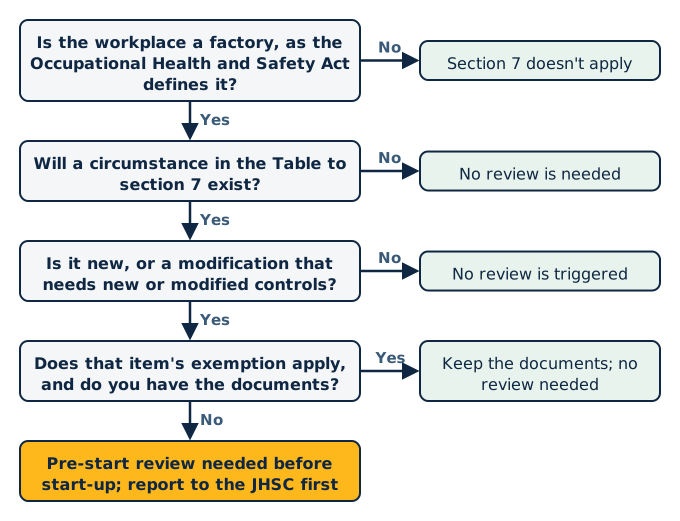
Section 7(2) of Reg. 851 puts the duty on the owner, lessee or employer. The ministry's guideline turns it into Flow Chart 1, "Determining when a PSR is required". Here's each step in plain words, with what usually decides it.
Steps 1 and 2: is the workplace a factory, and is it a logging operation?
Section 7 applies only "in a factory", as defined in the Occupational Health and Safety Act. That definition is broad. It covers manufacturing and assembling, and also places where power is used to work machinery for things like warehousing and repairing. The guideline's examples include auto parts and plastics plants, warehouses using forklifts, water treatment plants, recycling facilities and transit maintenance shops. If you're not a factory, section 7 doesn't apply. If you are a logging operation, section 7(3) says no review is required.
Step 3: will a Table circumstance exist?
The Table to section 7 has eight items, and only those eight. Each one pairs a circumstance with the provisions of Reg. 851 it relates to:
- more than 235 litres of flammable liquids in a building or room, or any dispensing of flammable liquids (flammable liquids)
- safeguarding devices that signal a machine to stop, such as light curtains, area scanners, safety mats and two-hand controls, or barrier guards with interlocks (machine guarding)
- material placed or stored on a rack or stacking structure (racking)
- a process with a risk of ignition or explosion that creates an imminent hazard (ignition and explosion hazards)
- a dust collector whose use involves a risk of ignition or explosion that creates an imminent hazard (dust collectors)
- a factory that produces aluminum or steel, or a foundry that melts or handles molten material
- a crane or other lifting device supported by a structure, or a vehicle lift or hoist (lifting devices)
- a process that uses or produces a hazardous biological or chemical agent and relies on ventilation to meet Reg. 833 exposure limits
No circumstance, no review. A new lathe with fixed guards and an emergency stop isn't an Item 2 trigger, because the guideline puts fixed guards and e-stops out of scope. There's no Table item for dip tanks or ovens as such; they come in through Item 4 if the process carries an ignition or explosion risk.
Steps 4 to 6: is it new, or a modification that needs new controls?
New or newly installed equipment, structures, protective elements and processes go straight to the exemption question. Existing ones only continue if a modification is planned, and then only if complying with the applicable provision will need new or modified engineering controls, other new or modified measures, or a combination.
The guideline draws the line between maintenance and modification. Maintenance restores something "to its original state as designed and installed", like swapping a worn interlock switch for the same model. A modification changes it from its original or current design, such as "replacement of a part with a non-identical part or changing the chemicals used in a process." Replacing a light curtain with a two-hand control counts as a new protective element.
Steps 7 and 8: does an exemption apply, and do you have the documents?
Each Table item has its own exemption, or none. Dust collector reviews under Item 5 and foundries and metal producers (Item 6) have none at all. Then comes the step people skip: the documents that establish the exemption have to be available. If they aren't, the flow chart's answer is that a review is required, even if the equipment would otherwise qualify.
The exemption flow charts in plain words
Flow Charts 2 to 6 cover the items that have exemptions. Each ends with the same question about documents.
Flow Chart 2: flammable liquids storage
If 235 litres or less are in the building or room, no review is needed for storage. Above that, you're exempt only if every condition holds: adequate cabinets (or a plan to replace them), no more than 235 litres per cabinet, no more than three cabinets in a group, and at least 30 metres between groups. Dispensing has no exemption, whatever the quantity, and the electrical equipment around a dispensing point often has to suit the zones on stamped gas and vapour classification drawings.
Flow Chart 3: machine guarding
The apparatus is checked first. It must have been manufactured to, or modified to meet, current applicable standards, and installed to those standards (if any) and the manufacturer's instructions. Then the protective element faces the same tests, with the installation question applying when the element was added after manufacture. A light curtain retrofitted to an older machine has to pass both halves. The engineer may also ask for a PL verification of the safety circuit, though ISO 13849-1 isn't on the guideline's list and won't establish the exemption on its own.
Flow Chart 4: racks
The rack must be designed and tested to the standard the guideline names, ANSI MH16.1-2012 (R2019), and you can't be making modifications that change the configuration, "for example, moving location of cross beams, installing wider uprights". Documentation must cover the rack as a whole, not just its components.
Flow Chart 5: spray booths
The booth must be manufactured and installed to current applicable standards and meet the Fire Code's definition of a spray booth. The exemption doesn't extend to equipment installed inside the booth, such as a painting robot.
Flow Chart 6: lifting devices
A vehicle lift or hoist must be certified to current applicable standards. For a crane or other structure-supported device, the supporting structure must have been originally designed for that lifting device, shown by engineer-sealed drawings or a report.
Item 8 ventilation has no flow chart, but it has one exemption: a portable extractor that doesn't exhaust to the outdoors, like a smoke hog on a welding bench.
Situations that change the answer
- Used equipment. Buying second-hand isn't an exemption, and an old machine often lacks the documents the exemption needs. See used equipment reviews.
- CE, CSA or ULC marks. The guideline says marks and labels don't show compliance with Reg. 851, so a mark alone never exempts equipment. A European declaration of conformity counts only if it names standards on the guideline's list. More on imported CE equipment.
- A review done somewhere else. Section 7 has no general exemption for equipment previously reviewed at another site.
- Relocation. Moving equipment within the same workplace needs no review if there are no triggering modifications and the move doesn't introduce hazards needing new or modified controls. Moving it to a different workplace isn't covered by that.
- Connected equipment. A review for one machine on a line doesn't automatically pull in the whole line. The guideline's example: interlocked-gate machines need a review, but the conveyors connecting them don't (they still have to comply with sections 24 and 25). Interlocked perimeter fencing around a system is different, and brings the whole system in.
- Already installed. If equipment went in without a review, one must still be completed (or an exemption documented) before it's operated. An inspector who finds it running can issue a Ministry of Labour compliance order, and sometimes requires a separate not likely to endanger (NLTE) report as well.
Who makes the call
You do. The guideline recommends a written procedure, built into purchasing, for deciding whether a review is needed whenever you buy or modify equipment, set up a process or restart modified equipment. The person applying it doesn't have to be an engineer. Write down the answer either way: if you rely on an exemption, section 7(8) requires the documents to stay readily accessible at the workplace for as long as the equipment does, and the JHSC or representative can ask for a copy.
The review itself, when it's needed, is done by an engineer for items 1 to 7. For item 8 it's a professional engineer or another qualified person, such as a certified industrial hygienist. Timing matters: the guideline calls a pre-start review "a design review prior to installation", and it must be complete before operation, including testing and commissioning.
Exemptions, item by item
- The only exemptions are the ones written into each item of the Table to section 7, plus logging operations. A CSA, ULC or CE mark, a previous review elsewhere, or used equipment is not an exemption on its own.
- An exemption only counts if the documents that establish it are available. They must name the standards met, and a European declaration that doesn't cite specific standards isn't acceptable.
- Keep the exemption documents readily accessible at the workplace for as long as the equipment stays there, and give a copy to the joint health and safety committee or representative if they ask.
- Some changes fall outside section 7 altogether: replacing a part with an identical one, or moving equipment within the same workplace without changes that trigger a review.
Item 1: Flammable liquids
No review is needed for 235 litres or less with no dispensing, or for storage in adequate cabinets (235 litres each, groups of three or fewer, 30 metres apart) with no dispensing. Dispensing never has an exemption. Flammable liquid exemptions and documents.
Item 2: Machine safeguarding
Fixed guards, emergency stops and pull cords on their own don't trigger item 2. Otherwise the exemption needs the machine and its protective elements made and installed to current applicable standards, with documents naming them and the installer's written statement. When a machine doesn't need a guarding review.
Item 3: Racks and stacking structures
A rack is exempt when documents show the whole system is designed and tested to ANSI MH16.1-2012 (R2019) and loads stay within the manufacturer's limits. Racks with elevated platforms or walkways fall under the Building Code instead. Rack exemption documents.
Item 4: Processes with a risk of ignition or explosion
A process inside a spray booth made and installed to current applicable standards is exempt. A robot or other equipment installed inside the booth isn't, and is reviewed on its own. What the spray booth exemption covers.
Item 5: Dust collectors
The Table gives no exemption, but the guideline puts four collector types outside item 5: wet collectors using an inert liquid, woodworking collectors under 0.47 m³/s that don't make wood flour, collectors built to contain an explosion, and explosion-resistant collectors vented outdoors. Dust collectors outside item 5.
Item 6: Aluminum or steel production and foundries
Item 6 has no exemption. The review covers how the workplace is set up around the melting unit. Scope of a foundry review.
Item 7: Lifting devices
Certified vehicle lifts are exempt, and so are cranes whose supporting structure was originally designed for them, shown by the original drawings or a sealed engineer's report. Crane and vehicle lift exemptions.
Item 8: Hazardous biological or chemical agents
A portable extractor that doesn't exhaust to the outdoors is exempt. Comfort heating and ventilation are outside item 8. When ventilation doesn't need a review.
The full conditions, the documents that establish each exemption and what doesn't qualify are on each item's page and in the estimator. Source: ministry guideline, exemptions.
If the answer is yes
If the subject is new to you, the home page sets out the basics of pre-start reviews in Ontario. After that, open the item page for your equipment, which covers what the engineer checks and what drives the fee. The section 7 pre-start review overview explains all eight items together. Then work through the printable PSR checklist so the engineer has drawings, manuals and supplier documents on the first day. Book early: a review that starts at the design stage costs less to act on than one that finds problems after the concrete is poured. To budget for it, pre-start review fees by item and region shows what each kind of review usually costs.
Questions people ask
When is a PSR required in Ontario?
When three things line up: the workplace is a factory (and not a logging operation), a circumstance in the Table to section 7 of Reg. 851 will exist, and the thing is either new or being modified in a way that needs new or modified controls or measures. Even then, a documented Table exemption removes the need for a review.
Does new equipment always need a PSR?
No. New equipment only needs a review if it creates a Table circumstance, such as a machine with a light curtain or interlocked guard, a new rack, or a crane on a building structure. A new machine with only fixed guards isn't an Item 2 trigger, and equipment that meets a Table exemption with documents in hand doesn't need one either.
Does modified or relocated equipment need a PSR?
A modification needs one if it falls under a Table item and compliance needs new or modified engineering controls or other measures. Replacing a part with an identical part is maintenance. Moving equipment within the same workplace needs no review if nothing about the move triggers section 7 and it introduces no hazards that need new or changed controls.
Can the employer decide whether a PSR is needed?
Yes. The owner, lessee or employer is responsible for deciding, and the ministry's guideline says the person doing that evaluation doesn't need to be an engineer. The guideline recommends a written procedure, tied into purchasing, for making the call whenever equipment is bought or modified. The review itself, if needed, is done by an engineer for items 1 to 7.
Is there a PSR flow chart?
Yes. The ministry's guideline includes six flow charts: one for deciding when a review is required, and five for the exemptions on flammable liquids, machine guarding, racks, spray booths and lifting devices. The guideline's Appendix 2 publishes them as accessible text, and this page and its checker follow the same steps.