
A lifting device pre-start review is required under Item 7 before a new or modified crane, monorail or hoist supported by a structure, or a vehicle lift, is used. It isn't needed when the structure was originally designed for the crane and sealed documents prove it, or when a vehicle lift is certified. The report covers structural adequacy.
Fabrication shops adding a jib to a column, plants hanging a monorail over an assembly line, crane runway extensions and fleet garages installing vehicle hoists make up most of this work. The question behind every crane pre-start review in Ontario, and every hoist or lift review, is whether the building steel, column, beam or slab can carry the device at its rated load, and the engineer's report has to answer it in writing.
For a typical overhead crane, the design review runs $5,200 to $6,100 + HST. Vehicle hoists usually cost less. Having the firm also witness the load test, or a project with several cranes, costs more.
What Item 7 covers
Item 7 of the Table to section 7 of Reg. 851 has two parts. The first is a travelling crane, overhead crane, monorail crane, gantry crane, jib crane or other lifting device suspended from or supported by a structure. The second is a vehicle lift or hoist. If either is being installed new, or modified in a way that needs new or changed controls, the review applies. For the rules shared by all eight items, read an overview of Ontario pre-start reviews.
Reg. 851 defines a lifting device as a device used to raise or lower any material or object, including its rails and other supports. That last part matters. The runway beams, the monorail track, the jib column and the brackets holding them to the building are all part of the device for this purpose.
| Usually inside Item 7 | Outside Item 7 |
|---|---|
| Top-running and under-running overhead bridge cranes | Forklifts and other lift trucks |
| Gantry cranes | Scissor lifts |
| Jib cranes, free-standing or column-mounted | Ergonomic lift and lower tables |
| Monorail beams with a hoist | Hook lifting devices and industrial manipulators |
| Automated storage and retrieval systems | Mobile cranes |
| Vehicle lifts and hoists in a maintenance shop | Elevating devices regulated by the TSSA, and permanently anchored rescue equipment |
The examples on the left come from the ministry guideline, which says they may require a PSR. Whether one actually does depends on the exemptions below and on whether the work is new or a qualifying modification.
When a lifting device pre-start review is required
The applicable provisions for Item 7 are sections 51 and 53. Section 51 says a lifting device must be built with enough strength, and with suitable ropes, chains, slings and fittings, to keep workers safe. It must be plainly marked so the operator can tell its maximum rated load. Section 53 requires rail stops or bumpers at both ends of a travelling crane's runway, at least as high as the centre of the wheels.
The PSR asks whether the installation will meet those provisions before anyone uses it. In practice, these are the projects that land on an engineer's desk:
- A fabrication shop adds a 2-tonne jib crane to an existing building column that was never designed for a side load.
- A plant hangs a monorail and electric chain hoist from the roof joists over a new assembly station.
- A crane runway is extended two bays, or a bigger hoist goes onto a bridge crane, so the structure now carries loads it wasn't originally designed for.
- A transit garage or fleet shop installs four-post and in-ground vehicle hoists that came without certification documents.
- A used gantry crane bought at auction is going to be set up in a different building.
The two exemptions, and the paperwork behind them
A structure originally designed for the crane
No PSR is needed if the supporting structure was originally designed for the crane or lifting device being installed or used. The key word is "originally". A building designed in the 1990s for a 5-tonne crane wasn't designed for the 10-tonne unit you want to put on the same runway today.
The guideline is specific about proof. You need the design drawings, or a report containing the design loading capacity of the original support structure, and they must bear the signature and seal of an engineer. A capacity letter from the crane supplier without a seal doesn't establish the exemption, and neither does a general belief that "the building was built for cranes". No documents, no exemption.
Free-standing jib and gantry cranes raise a fair question, since the crane's own frame is the supporting structure. The guideline lists free-standing jib cranes among the examples that may require a PSR and doesn't rule on it further, so ask the engineer to look at what the manufacturer supplied.
A certified vehicle lift or hoist
A vehicle lift or hoist is exempt if it's certified as meeting current applicable standards. The guideline names ANSI/ALI ALCTV-2011, Automotive Lifts: Safety Requirements for Construction, Testing and Validation, and notes that the Automotive Lift Institute maintains lists of certified lifts and hoists. Keep the certification documents with your records. Don't assume a newer edition of the standard qualifies automatically; the engineer decides that.
The guideline also says vehicle lifts should be installed by trained workers following the manufacturer's or an Ontario-licensed engineer's instructions. That's good practice, not a condition of the exemption.
The generated section near the end of this page lists the exemption documents in full. For a side-by-side view with the other items, read how exemptions work across the Table.
What the engineer checks
Section 7(5)(d)(ii) requires the report for Item 7 to include details of the structural adequacy of the apparatus or structure. The guideline tells the reviewer to focus on the adequacy of the supporting structure, which includes rails, frames and posts, and on capacity.
For a bridge crane, that means the runway girders, their connections to the columns, the columns themselves, and the rail stops section 53 requires. For a jib, it's the column or wall mounting and the anchorage. For a monorail, it's the beam and every hanger up to the building steel. The guideline points to the Building Code, CSA S16.1, CSA S136, CSA S157 and the Civil Engineering Handbook as references. CSA B167 covers the cranes and hoists themselves; the guideline doesn't cite it for the structural review, but many engineers will look at it.
If the device will be load tested before it goes into service, the report must also set out how workers will be protected during that testing, under section 7(5)(d)(iii). That's separate from the examination section 51 requires by a competent person before first use and at least once a year after that, with a signed record. The PSR doesn't replace that examination.
If an inspector later doubts an installed crane, that calls for a different document: a sealed report under OHSA s.54(1)(k).
Expect the engineer to compare the rated load on the hoist with what the structure can carry, not just with what the crane can lift. Where the structure is the weaker link, the report may limit the rated capacity, call for reinforcement, or both. Section 51 then requires the device to be plainly marked so the operator can tell the maximum rated load under any operating condition, so a derated crane needs its markings changed before start-up. An automated storage and retrieval system gets the same structural treatment: the rails and frames it runs on are its supporting structure.
Documents to have ready
- Crane or hoist make, model, rated capacity, span and weight, from the manufacturer's data sheet
- Wheel loads and runway reactions, if the crane supplier has provided them
- Original building or support structure drawings, ideally sealed, and any later structural reports
- Drawings or sketches showing where the device mounts and how it connects
- For vehicle lifts, the certification documents and the installation instructions
- For used or relocated devices, the previous inspection records and the history of any repairs
The general list of documents to gather before the visit covers the rest.
What drives the fee
A single two-post hoist on a sound slab is a short job. A 20-tonne bridge crane on an extended runway is not. The estimator asks about the factors that make the difference:
- Device type. Bridge cranes need the runway and supporting structure checked. Monorails need the beam and its supports. In-ground hoists need the pit and floor installation looked at.
- Capacity. Heavier capacities mean more structural analysis, and over 20 tonnes the checks get more involved.
- Load testing. The pre-start review itself is a design review, so it doesn't include test weights. Load testing adds site time and test weights only when the firm also witnesses or runs the load test, or does the section 51 examination. The estimator asks which you want.
- Number of devices. Each one needs its own inspection, and seven or more usually take a second site day.
- Mounting. A device attached to the building means checking that the building can carry it.
- Condition and documents. Used or relocated devices need their condition and the new structure checked. Missing drawings mean the engineer has to work things out from the steel itself.
| Situation | Typical engineering fee |
|---|---|
| Bridge crane, 5 to 20 t, building-mounted, design review only, GTA | $5,200 – $6,100 + HST |
| Bridge crane with load test witnessed by the firm | $6,600 – $7,700 + HST |
| Jib crane | $4,050 – $4,750 + HST |
| Monorail hoist | $4,650 – $5,400 + HST |
| Bridge crane over 20 t | $5,700 – $6,600 + HST |
| Two-post vehicle hoist, not certified | $1,750 – $2,050 + HST |
| Bridge crane, Kingston region | $5,900 – $6,900 + HST |
Estimates from typical Ontario engineering fees, worked out by the same calculator as the estimator on this page (GTA unless the row names another region). They aren't quotes: the firm confirms its fee after reviewing your documents.
Cranes sit in the middle of the range; Ontario pre-start review prices by item puts them next to the other seven items.
A deadline set by an MOL compliance order is the most expensive timing, because the firm has to drop other work.
Timeline and start-up
The guideline describes the PSR as a design review before installation. Call the engineer when the crane is ordered and the mounting location is chosen, not after the runway is up. If a column needs reinforcing, you want to know before the steel erector leaves site.
Once the report is in, any measures it lists must be completed before the device is used, or the joint health and safety committee or health and safety representative must get written notice of what was done, under section 7(6). The report goes to the committee or representative before first use. Keep it, with the supporting drawings, readily accessible for as long as the device stays in the workplace.
If you later move the crane to a new structure or upgrade the hoist, plan on a new review: a different supporting structure, or a heavier load on the old one, is exactly what Item 7 looks at. A ladle crane in a melt shop sits alongside a foundry pre-start review of the floor around the furnace. A rack project with an automated retrieval system may also involve Item 3 for the racking, and the summary of all eight section 7 items puts each one in context.
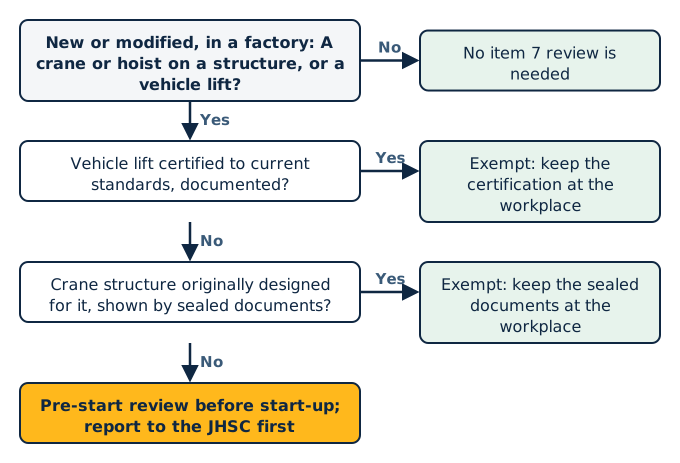
When you don't need a PSR
Vehicle lifts are exempt when certified to current standards, and cranes when the building structure was designed for them and sealed documents show it. A licensed engineer can confirm an exemption from your documents for a smaller fee than a full review.
Certified vehicle lifts
Item 7 doesn't require a review for a vehicle lift or hoist that has been certified as meeting current applicable standards.
Documents that establish it:
- Proof of certification to current applicable standards (the guideline names ANSI/ALI ALCTV and the ALI lists of certified lifts)
- The manufacturer's installation instructions and records showing it was installed to them
Structure originally designed for the crane
Item 7 doesn't require a review when the supporting structure was originally designed for the crane or lifting device being installed, and you can show it.
Documents that establish it:
- The original design drawings, or a report giving the structure's design loading capacity, signed and sealed by an engineer (an unsealed letter doesn't qualify)
- The crane or hoist manufacturer's documentation and rated capacity
What doesn't qualify
- An unsealed letter about the structure doesn't establish the crane exemption.
Outside item 7
- Forklifts, scissor lifts, ergonomic lift tables, hook lifting devices, manipulators and mobile cranes.
- Elevating devices regulated by the TSSA.
A mark such as CSA, ULC or CE isn't an exemption on its own. See all section 7 exemptions in one place, or the ministry guideline for item 7.
Questions people ask
Does a new hoist or monorail need a PSR?
If it hangs from or is supported by a structure, usually yes, unless that structure was originally designed for it and you have the engineer-sealed drawings or report to prove it. Bolting a monorail beam to existing roof steel is the classic case that needs a review. A vehicle hoist needs one unless it's certified to current applicable standards.
Are forklifts and scissor lifts excluded from Item 7?
Yes. The guideline lists forklifts, scissor lifts, ergonomic lift and lower tables, hook lifting devices, industrial manipulators, mobile cranes and permanently anchored rescue equipment as outside Item 7. Elevating devices regulated by the TSSA are excluded by the definition of lifting device in Reg. 851.
Is a PSR needed if the building was designed for the crane?
Not if you can prove it. The exemption needs the original design drawings, or a report giving the design loading capacity of the original support structure, signed and sealed by an engineer. Without that paperwork, a PSR is required even if the building probably was designed for a crane.
Is an ALI-certified car hoist exempt from a PSR?
It can be. The Table exempts a vehicle lift or hoist certified as meeting current applicable standards, and the guideline names ANSI/ALI ALCTV-2011 and notes that the Automotive Lift Institute keeps lists of certified lifts. Keep the certification documents on file, and ask the engineer whether a lift certified to a later edition is read the same way.
Is a PSR needed when a crane is relocated?
A move within the same workplace needs no PSR if nothing triggering is modified and no new controls are needed. For a crane, though, the new location usually means a different supporting structure that wasn't originally designed for it, and that is exactly what Item 7 reviews. Moving it to another workplace takes it outside the relocation rule altogether.
Does a car hoist in a repair shop or dealership need a PSR?
Only if it isn't certified. Repair shops and dealership service bays are usually factories under the OHSA definition, so a new hoist needs an Item 7 review unless it's certified as meeting current applicable standards and you keep the documents. The guideline points to the Automotive Lift Institute's lists of certified lifts, so check there first. The vehicle lift exemption sets out the documents you need.