
A not likely to endanger engineer report in Ontario is the sealed report an inspector can require under section 54(1)(k) of the Occupational Health and Safety Act. A professional engineer examines, and where needed tests, the equipment or structure named in the order and states whether it is likely to endanger a worker.
A not likely to endanger engineer report, often called a "not likely to endanger letter" or an "NLTE certificate", usually follows an Ontario inspector's visit where something on a crane runway, a mezzanine or a guarded machine couldn't be settled on the spot. Production on that equipment often waits on the engineer, because the same order can bar its use until testing is done, and the employer pays for the testing as well as the report. It typically costs $3,700 to $4,350 + HST for a single machine, more for cranes, hoists and structures that need load testing.
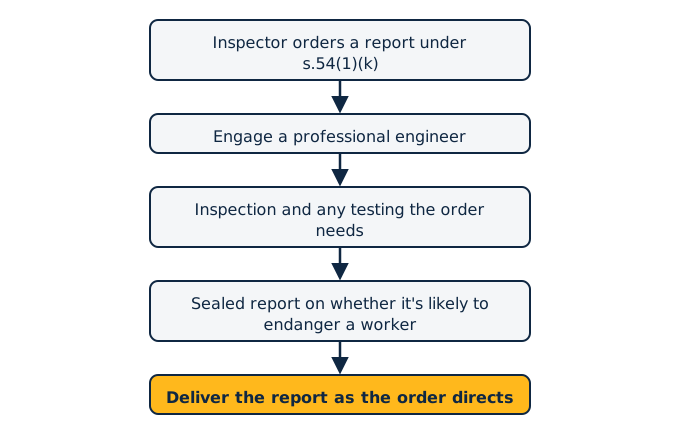
What you get: one sealed report about specific equipment
The deliverable is a written report, signed and sealed by an Ontario-licensed engineer, that answers the question the inspector put in writing. Engineers lay these out differently, but a report that holds up to an inspector's reading usually contains:
- the order or requirement it responds to, quoted or referenced by number and date
- exact identification of the equipment: make, model, serial number, location in the plant, rated capacity
- the scope of the engineer's review, and anything deliberately left outside it
- the testing performed, the method, who did it, and the results (test certificates from an outside lab attached)
- findings, including deficiencies and how they were corrected before the final test
- the statement that the equipment is not likely to endanger a worker, with any conditions on its use
- the engineer's seal, signature and the date
The statement is narrow on purpose. It's about the equipment named in the order, in the condition and configuration tested. If you later change the machine, move the crane to a different runway or raise the rated load, the report no longer speaks to it.
When Ontario inspectors ask for a not likely to endanger engineer report
The power comes from clause 54(1)(k) of the Occupational Health and Safety Act. An inspector can "require in writing an employer to have equipment, machinery or devices tested, at the expense of the employer, by an engineer and to provide, at the expense of the employer, a report bearing the seal and signature of the engineer stating that the equipment, machine or device is not likely to endanger a worker."
It tends to appear when the inspector can see a possible problem but can't settle it on the spot. Some typical situations:
- An overhead crane with visible runway damage or a cracked weld at the end truck.
- A mezzanine or platform with no capacity signage, carrying more stock than anyone can account for.
- A machine where a guard interlock was bypassed and later "repaired" by a contractor, with no record of what changed.
- A vehicle hoist after a lifting incident, where the inspector wants the structure and locks verified before anyone works under it again.
Clause (l) is often written alongside it: the inspector can require that the equipment not be used pending the testing. Read the inspector's written order carefully to see whether that applies, because it decides whether production waits on the engineer.
How the engineer tests the equipment
The clause says "tested", so a desk review of drawings alone won't do. The engineer picks the tests that actually answer the inspector's concern, and the order's wording shapes the scope.
Functional testing
For machines, this means operating the safety functions and proving they work as intended: opening an interlocked gate while the machine is cycling, breaking a light curtain at different heights, checking stopping performance, and confirming that a single fault doesn't leave the machine able to restart. Where the reliability of the safety circuit is the real question, the engineer may verify it against ISO 13849-1, which is exactly the job of a performance level (PL) assessment.
Load testing
Cranes, hoists, monorails and some platforms are proof-tested with a known load, applied in steps while the engineer watches for deflection, slippage or distress. Test weights have to be sourced and rigged, which adds site time and a disbursement. The engineer sets the test load and procedure with reference to the standard that fits the equipment, and plans how workers stay clear during the test.
Non-destructive testing (NDT)
Where cracks or weld quality are in question, a testing company inspects the welds or components using methods the engineer specifies, such as magnetic particle or ultrasonic testing. The testing company issues its own results, and the engineer interprets them in the report. NDT is billed to you as a disbursement.
Structural and documentation review
Behind the testing, the engineer checks what the equipment was designed for: original drawings, capacity ratings, manufacturer's manuals, previous inspection records. For a crane, that includes whether the supporting structure was designed for it, the same question that sits at the centre of a lifting device pre-start review.
If a stop-use requirement is in place, confirm with the inspector how the test runs themselves will be handled before the engineer arrives. Clause 54(1)(j) is the related power that allows an inspector to require equipment be operated for an examination or test.
If the answer is no
An engineer can't seal a statement the evidence doesn't support. When testing shows a problem, you'll get the findings in writing with what has to be repaired, replaced or changed. The equipment stays out of service, the repair gets done, and the engineer retests before issuing the report.
Watch the type of repair. Replacing a part with an identical part is maintenance. But if the fix adds a light curtain where there wasn't one, swaps a guard for a different kind of device, or reinforces a structure, it may count as a modification under section 7 of Reg. 851, and an Item 2 safeguarding review or another Item review could be required before the equipment runs again. The checker shows whether a pre-start review is triggered by the repair.
Sealing and who can sign
The report has to bear "the seal and signature of the engineer". OHSA s.1 defines engineer as a person licensed as a professional engineer, or holding a limited licence, under the Professional Engineers Act. Sealing follows the Professional Engineers Act and its regulation, and it confirms that a licence holder takes professional responsibility for the content.
A firm offering this work to the public needs a certificate of authorization (Professional Engineers Act s.12(2)). The licensed engineer we connect you with will work for a firm that holds one, in a discipline that fits the equipment: structural for runways and platforms, mechanical or electrical for machine safety functions.
Inputs that speed it up
The engineer can often quote from photos and the order alone, but the visit goes faster with these ready:
- The full written order, every page.
- Nameplate photos and the serial number.
- Manuals, electrical schematics, and original design drawings for structures.
- Maintenance and inspection records, plus any earlier engineer's reports or pre-start reviews.
- A list of what's been repaired since the inspector's visit, with invoices if a contractor did it.
- Access arrangements: a qualified operator for functional tests, lockout coordination, and a forklift or crane if test weights need placing.
What drives the fee
Equipment type comes first. A single machine with a functional test sits at the lower end. Cranes and hoists need structural and load checks; a platform or structure needs a structural assessment; elevating devices bring their own code requirements.
Testing is the next driver: a load test adds test weights and site time, NDT adds a testing company's charges, and leaving the testing question open at quote stage widens the range. The compliance date pushes the price up when it's within two weeks. Missing documents add desk time because the engineer has to reconstruct ratings from the equipment itself. It's the same problem that makes pre-start reviews of used equipment take longer. When the order follows a missed pre-start review, the fees for the review you still need come on top of this report.
| Situation | Typical engineering fee |
|---|---|
| Machine, 2 to 4 weeks to comply, GTA | $3,700 – $4,350 + HST |
| Machine, compliance within a week | $5,400 – $6,300 + HST |
| Crane, with a load test | $7,300 – $8,600 + HST |
| Structure or platform, with NDT | $7,600 – $8,900 + HST |
| Machine, Sudbury region | $4,200 – $4,950 + HST |
Estimates from typical Ontario engineering fees, worked out by the same calculator as the estimator on this page (GTA unless the row names another region). They aren't quotes: the firm confirms its fee after reviewing your documents.
Timeline
Because these reports are tied to a compliance date, firms usually schedule the visit within days of being engaged. The report typically follows 3 to 10 business days after the visit, timed to the order. Outside NDT and test-weight logistics can add a few days, so mention them when you first call. If the schedule can't meet the date on the order, speak to the inspector before it passes.
What this report isn't
It isn't a pre-start health and safety review. A section 7 pre-start review is a design review you arrange before new or modified equipment runs, and it sets out the measures needed to comply with the applicable provisions of Reg. 851. A s.54(1)(k) report answers an inspector's question about existing equipment after the fact. If the order cites section 7, you need the review (or a documented exemption, see the exemptions overview), and this report won't substitute for it. The same goes for a new machine imported with a CE mark: it needs its review, or a documented exemption, before first start-up.
It also isn't a routine inspection program. Periodic crane and rack inspections are separate maintenance duties, and they carry on after the order is closed. A new or reconfigured rack is a different matter again, handled by an Item 3 rack pre-start review.
Questions people ask
What is a 'not likely to endanger' engineer report?
It's the report described in OHSA s.54(1)(k). An inspector requires it in writing, an engineer tests the equipment named in the requirement, and the report, bearing the engineer's seal and signature, states that the equipment is not likely to endanger a worker. You pay for both the testing and the report. Site teams often call it an NLTE letter or certificate, but it's the same sealed engineer's report.
Will an engineer's report clear an MOL order?
It gives the inspector the evidence the order asked for, but it doesn't close the order by itself. Under OHSA s.59(4), compliance is achieved when an inspector determines it has been, so you send the report with your notice of compliance and the inspector decides. A report that doesn't address the specific equipment and concerns in the order is likely to come back.
What does OHSA 54(1)(k) allow an inspector to require?
It allows an inspector to require in writing that an employer have equipment, machinery or devices tested by an engineer, and provide a report bearing the engineer's seal and signature stating the equipment is not likely to endanger a worker. Clause (l) goes with it and allows the inspector to require that the equipment not be used pending that testing.
Who pays for the engineer's test?
The employer. Clause 54(1)(k) says the testing and the report are both "at the expense of the employer". That includes disbursements such as test weights or an outside non-destructive testing company if the engineer needs them.
What if the engineer finds the equipment is likely to endanger?
Then the engineer can't sign the statement the order asks for. You'll get the findings and what has to be repaired or changed, the equipment stays out of service, and the engineer retests after the work. If the fix adds or changes a protective element, check whether it now needs a pre-start review under section 7 of Reg. 851.