
A machine guarding pre-start review is required under Item 2 of section 7 when a new or modified machine relies on light curtains, scanners, safety mats, two-hand controls or interlocked guards. A licensed engineer checks the safeguarding against Reg. 851 and issues a sealed report before start-up, unless the documented standards exemption applies.
Most Item 2 jobs start with a purchase order: a press brake with a light curtain, a robot cell behind fencing with interlocked gates, or a packaging machine whose access doors cut power when opened. The person who books the machine guarding pre-start review is usually the plant manager, maintenance lead or project engineer responsible for the installation, and what decides it is the kind of protective element, not the size or price of the machine. A typical single-machine review runs $3,800 to $4,500 + HST.
When section 7 requires a machine guarding pre-start review
Item 2 of the Table to section 7 covers two kinds of protective element used with an apparatus. The first is a safeguarding device that signals the machine to stop: light curtains and light screens, area scanners, radio-frequency and capacitance systems, safety mats, two-hand controls and two-hand tripping, and single or multiple beam systems. The second is a barrier guard that uses interlocking mechanical or electrical safeguarding devices, such as an interlocked access door or perimeter fence gate.
The review is triggered when one of those elements is part of a new machine being installed, or when an existing machine is modified in a way that needs new or changed engineering controls to keep meeting the guarding sections of the regulation. You can read the Table row itself on e-Laws. The legal duty sits with the owner, lessee or employer, not with the machine builder. If section 7 is new to you, this summary of how pre-start reviews work sets out the general rules first.
What doesn't trigger Item 2
The ministry guideline puts four things out of scope, even when they replace one of the listed devices: emergency stop buttons and pull cords, fixed barrier guards, holdback devices and pullback devices. A machine guarded only with bolted-on fixed guards and fitted with e-stops doesn't need an Item 2 review. That machine still has to comply with the guarding sections; it just doesn't need the pre-start review.
Like-for-like maintenance is also outside section 7. Swapping a failed safety relay for the identical part restores the machine to its original design. Fitting a part with different specifications is a modification, and that can trigger a review.
Three situations that do
- A robot cell going in over a long weekend. The cell has interlocked perimeter fencing and an area scanner at the load station. Interlocked fencing brings the whole system into the review, and the guideline names robots integrated with machines (including a replacement robot) as a typical trigger. The review has to be finished before anyone runs the cell, including for commissioning and testing.
- A light curtain swapped for a two-hand control. The operator wants the light curtain gone on a small press. The guideline treats this as a new protective element, so a review is required even though the machine itself hasn't changed.
- A used press brake bought at auction. It arrives with a light curtain and no paperwork. Installing it in your plant is a new installation, and without documents there's no exemption to claim. The used equipment page covers this case in more detail.
When only one machine on a line triggers Item 2, the review covers that machine. A robotic welding cell often needs more than a guarding review: if its fume extraction keeps welders under Reg. 833 limits, that system is reviewed under Item 8 for hazardous substances.
Machines that most often need an Item 2 review
Robot cells and cobots
A conventional robot cell usually triggers Item 2 through interlocked perimeter fencing, light curtains at load stations or an area scanner. A collaborative robot triggers it the same way when it relies on a listed device, such as an area scanner that slows or stops the robot. Whether a cobot's power and force limiting changes anything is a question for the engineer. The engineer checks the cell layout, safety distances, interlocks and the risk assessment against CAN/CSA Z434, the robot standard the guideline names.
Press brakes and power presses
Presses are the classic Item 2 machines: light curtains, two-hand controls and two-hand tripping are all on the list of protective elements. A new or used press brake with a light curtain, or a power press switched from one device to another, needs a review. The engineer checks stopping time against the mounting distance of the curtain, two-hand control timing and position, and the guarding at the point of operation. CAN/CSA Z142, the power press standard, is on the guideline's accepted list.
CNC machines
Most CNC machines bring an Item 2 review through their interlocked doors or enclosures, which count as barrier guards with interlocking devices. A machine guarded only by fixed panels doesn't. The engineer checks that opening a door stops hazardous motion, that the interlock is the right type and mounted so it can't easily be bypassed, and how setup or maintenance modes with the door open are controlled. Machine-specific ANSI B11 standards and ISO 14119 on interlocks are among the guideline's references.
Palletizers and packaging lines
Palletizers and packaging lines usually combine interlocked fence gates with light curtains at the infeed and outfeed, where product passes through while people must not. Muting, which lets a pallet through the curtain, is a common focus of the review. The engineer checks the whole guarded zone: gate interlocks, curtain placement, muting logic and what happens when someone has to clear a jam. Interlocked fencing around several machines brings the whole fenced system into the review; a single machine that uses a listed device on an otherwise unguarded line is reviewed on its own.
Conveyors
A conveyor needs an Item 2 review only when it uses one of the listed devices, such as a light curtain or an interlocked guard at a transfer point. Emergency stop pull cords and fixed guards don't trigger Item 2. A conveyor without a listed device still has to meet the guarding sections of the regulation, including ss. 24 and 25 on moving parts and in-running nip points, even though no pre-start review is needed. The engineer checks the listed devices and the nip points around them.
What the engineer checks
The applicable provisions for Item 2 are sections 24, 25, 26, 28, 31 and 32 of Reg. 851. In plain terms: exposed moving parts and in-running nip points must be guarded so workers can't reach them (ss. 24 and 25); the machine must be shielded so the product, material or waste stock can't injure anyone (s. 26); an operating control that acts as a guard must sit where the operator is safe, be protected from accidental operation and be impossible to defeat with a tie-down (s. 28); centrifugal extractors, separators and dryers need lid interlocks (s. 31); and tumbling mills and dryers need a locking device for loading and unloading (s. 32).
The engineer reviews the design against those sections, usually from drawings, the risk assessment and a site visit. For a light curtain, that means checking the stopping time and the mounting distance so a hand can't reach the hazard before the machine stops. For interlocked guards, it means checking the interlock type, how it's mounted, and whether it can be bypassed easily. For a two-hand control, it means checking timing and the distance from the controls to the hazard.
Standards that genuinely apply
The ministry's Item 2 page lists the standards it has reviewed and accepts as current applicable standards. They include CSA Z432 (2014) for safeguarding of machinery, CAN/CSA Z142 (2010) for power presses, CAN/CSA Z434 (R2013) for industrial robots, several ANSI B11 machine standards, ISO 12100 for risk assessment, ISO 13857 and ISO 13854 for safety distances and gaps, ISO 14119 for interlocks, ISO 14120 for guards, ISO 13856 for pressure-sensitive devices such as mats, and IEC 61496-1 and -2 for light curtains and other electro-sensitive equipment. A second list, which includes ISO 13855 and the European machine standards, can support a review but hasn't been checked by the ministry.
Robot cells deserve a note. The guideline still names CAN/CSA Z434 (R2013), and a newer CSA Z434 edition based on ISO 10218 has been announced. The engineer decides which edition applies to your cell; don't assume a newer edition automatically satisfies the exemption.
ISO 13849, the standard for the performance level of safety-related control circuits, isn't on either ministry list. If your project needs the safety circuits verified to a required performance level, that's a separate piece of work. See the performance level assessment page for what it involves.
Documents to have ready
The more of this the firm gets up front, the less time is spent on desk research. Send what you have, even if it's incomplete.
- The machine manual, including the safety chapter and the installation instructions.
- General arrangement drawings and a layout showing operator positions, access points and fencing.
- Electrical and safety-circuit drawings: safety relays or safety PLC, interlock wiring, light curtain wiring.
- Data sheets for each safety device, with the published response time.
- Any measured stopping-time data for the machine.
- The supplier's risk assessment, if one was done.
- The declaration of conformity or manufacturer's certificate, showing which standards were used.
- For a modification: the original drawings and a clear description of what's changing.
- Your target start-up date and who's installing the equipment.
Print the preparation checklist if you'd rather have these grouped by project stage, from purchase order to installation.
What drives the fee
A machine guarding review is mostly engineering hours: reading documents, a site visit, analysis and writing the report. Anything that adds hours moves the price.
The type of equipment matters most. A standalone machine with one interlocked door is the simple case. A robot cell needs safeguarding distances checked at every access point. A palletizer has several hazard zones plus infeed and outfeed openings. A press or press brake needs stopping-time and safety-distance checks. A multi-machine line means reviewing each machine and the interfaces between them, usually over two visits. Die-casting cells can raise a second question, since some casting operations also fall under Item 6 for foundries; the engineer confirms which.
The number of machines scales the site and report time, with some shared paperwork when several are reviewed together. The safety devices count too: light curtains and scanners need response-time and mounting-distance checks, and two-hand controls need timing and placement checks.
Condition and paperwork are the quiet multipliers. Equipment with complete manuals and safety-circuit drawings is quicker to review than a machine with none, where the engineer has to work it out from the equipment itself. CE-only imports need a gap review against Canadian requirements, covered on the imported CE equipment page. Finally, timing: a review needed within a week, or to meet the deadline in a ministry order, costs more because the firm has to move other work.
| Situation | Typical engineering fee |
|---|---|
| One standalone machine, GTA | $3,800 – $4,500 + HST |
| Robot cell | $8,300 – $9,800 + HST |
| Palletizer | $7,300 – $8,500 + HST |
| Multi-machine line | $18,900 – $22,200 + HST |
| Used machine | $6,100 – $7,200 + HST |
| Imported, CE-marked only | $6,600 – $7,700 + HST |
| One machine, needed within a week | $4,600 – $5,400 + HST |
| One machine, MOL order deadline | $5,200 – $6,100 + HST |
| One machine, Thunder Bay | $6,300 – $7,400 + HST |
Estimates from typical Ontario engineering fees, worked out by the same calculator as the estimator on this page (GTA unless the row names another region). They aren't quotes: the firm confirms its fee after reviewing your documents.
To see how a guarding review compares with the other Table items, check pre-start review costs across Ontario.
The estimator on this page applies these drivers to your own answers. Guarding hardware, installation work, re-inspection after fixes and performance level calculations are normally priced separately.
Timeline from first call to start-up
Most firms can visit three to ten business days after you engage them, and one to two weeks later than that in northern Ontario. The report usually follows five to ten business days after the visit, or two to four weeks for a full line. With a hard deadline, many firms can visit within days and issue the report shortly after.
The guideline describes a PSR as a design review before installation, not an as-installed inspection. Book it when the layout and safety devices are chosen, not the week the riggers arrive. An as-built check after installation is recommended practice but not required by section 7.
After the report
The report lists the measures needed to comply with the Item 2 provisions, or states clearly that none are necessary. Typical findings include moving a light curtain further from the hazard, adding a fixed guard to close a gap, changing an interlock to a type that's harder to defeat, or adding a reset outside the guarded area.
Section 7(6) says the machine can't be run until the review is done and either every required measure is in place, or you've given the joint health and safety committee (or health and safety representative) written notice of the measures taken to comply. Section 7(7) adds that a copy of the report must go to the committee or representative before the machine is operated. Keep the report and its supporting documents readily accessible at the workplace for as long as the machine stays there; an inspector can ask for them at any time. An inspector who doubts an existing guard can also require testing and an engineer's report that the machine is not likely to endanger a worker, which is a different document from this review.
If the machine might qualify for an exemption instead, the section below sets out the conditions and documents. You can also work out whether a review applies by answering the ministry's flow chart questions one at a time.
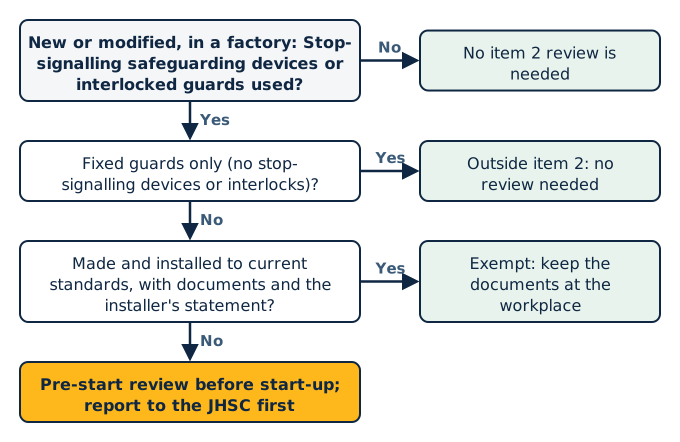
When you don't need a PSR
A machine protected only by fixed guards is outside item 2, and a machine whose guarding was made and installed to current standards is exempt if the paperwork proves it. A licensed engineer can confirm an exemption from your documents for a smaller fee than a full review.
Fixed guards only
Item 2 covers safeguarding devices that signal the machine to stop (light curtains, scanners, mats, two-hand controls) and interlocked guards. Fixed guards, emergency stops and pull cords on their own don't trigger it.
Documents that establish it:
- A description or photos of the guarding showing it is fixed (no interlocks or presence-sensing devices)
- The machine's manual
Made and installed to current applicable standards
Item 2 doesn't require a review when the machine and its protective elements were made to current applicable standards and installed to those standards and the manufacturer's instructions, and the documents show it.
Documents that establish it:
- The manufacturer's certificate or purchase documents stating the machine and its guarding meet current applicable standards, naming them (a CE declaration must list the standards; a CE mark alone doesn't count)
- The installer's written statement that it was installed to those standards and the manufacturer's instructions
- For guards added later: the same documents for the guard
What doesn't qualify
- Replacing a guard with a different kind of device (for example a light curtain swapped for a two-hand control) counts as a new protective element.
- Interlocked perimeter fencing around a cell brings the whole system into the review.
Not covered by item 2
- Emergency stops and pull cords.
- Fixed guards.
- Holdback and pullback devices.
A mark such as CSA, ULC or CE isn't an exemption on its own. See every exemption, item by item, or the ministry guideline for item 2.
Questions people ask
Does machine guarding need a PSR in Ontario?
Only some of it. Item 2 of the section 7 Table applies when a new or modified machine uses a stop-signal safeguarding device (a light curtain, scanner, safety mat, two-hand control or beam system) or an interlocked barrier guard as a protective element. Fixed guards, emergency stops, pull cords and holdback or pullback devices on their own don't trigger a review.
What triggers an Item 2 PSR (protective element that signals the machine to stop)?
The trigger is a new or modified protective element of one of two kinds: a safeguarding device that signals the apparatus to stop, or a barrier guard that uses interlocking mechanical or electrical devices. A new machine arriving with either one triggers it, and so does adding one to an existing machine. Swapping one device type for another, such as a light curtain for a two-hand control, counts as a new protective element.
Is CSA Z432 enough to claim an exemption?
Not by itself. CSA Z432 (2014) is on the ministry's list of standards accepted for the Item 2 exemption, but you also need the machine installed to current applicable standards and the manufacturer's instructions, and documents that show both, including the installer's written statement. Whether a document citing the newer CSA Z432 edition is accepted without further engineering assessment isn't settled by the guideline, so the engineer makes that call.
Can a guarded machine be test-run before the PSR is finished?
No. Section 7 requires the review before the machine is operated, and the guideline counts commissioning and test runs as operation. If the integrator needs power on to tune a light curtain or prove an interlock, the report has to say how workers will be protected during that testing. Book the engineer's visit before the integrator's commissioning week, not after it.
What are the machine guarding requirements in Ontario?
The core rules are in Reg. 851 sections 24 to 32. Exposed moving parts and in-running nip points must be guarded so workers can't reach them, machines must be shielded so material and waste stock can't injure anyone, and an operating control that acts as a guard must be placed safely, protected from accidental operation and impossible to tie down. Items such as centrifugal extractors and tumbling mills have their own interlock and locking rules.
Does replacing a light curtain trigger a PSR?
Replacing it with an identical unit is maintenance and doesn't. Replacing it with a different model or specification is a modification that could trigger one, and replacing it with a different kind of device, such as a two-hand control, is treated as a new protective element. Keep the purchase records that show a like-for-like swap.