
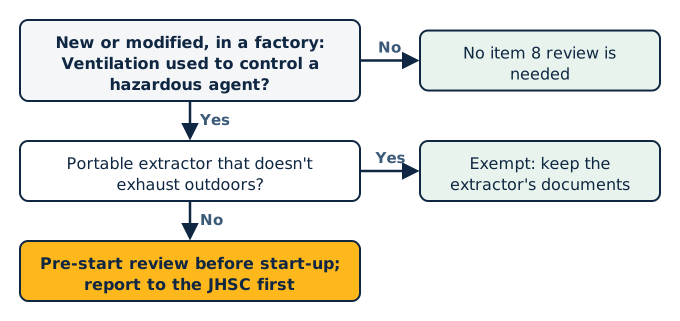
A ventilation pre-start review for hazardous substances is required under Item 8 when a new or modified process uses or produces a hazardous biological or chemical agent and relies on ventilation to meet Reg. 833 exposure limits. A professional engineer or another qualified person, such as a certified industrial hygienist, can do it. Portable recirculating extractors are exempt.
Welding shops, solvent wipe-down stations, quality labs with fume hoods and any process switching to a more toxic product are the typical cases, and most of them rely on local exhaust ventilation (LEV). A ventilation pre-start review in Ontario ends with measurement: the reviewer checks airflow at each hood and confirms worker exposure with air sampling once the system runs, so plan for two visits rather than one.
For a typical single local exhaust system, the review runs $6,500 to $7,700 + HST. More systems, biological agents or designated substances raise it.
When Item 8 applies
Item 8 of the Table to section 7 of Reg. 851 applies when "a process uses or produces a hazardous biological or chemical agent and uses a ventilation system to limit the exposure of a worker" in line with an exposure limit in Reg. 833, Control of Exposure to Biological or Chemical Agents. Both halves have to be true. A solvent process with no ventilation control isn't Item 8, though it has other problems. A ventilation system that only keeps the office comfortable isn't Item 8 either.
The guideline puts the purpose plainly: the review is there to check the ability of the ventilation system to control the exposure. It's not an audit of every chemical on site.
As with every Table item, section 7(2) triggers the review for a new process, or for a modification that needs new or changed controls. The guideline's own definition of modification includes changing the chemicals used in a process, which surprises a lot of plant managers. Some typical cases:
A metal fabricator adds a robotic welding cell with a fixed fume hood ducted through the roof. A plastics plant installs a slot hood over a new solvent wipe-down station. A food plant's quality lab gets two new fume hoods for acid digestions. A coatings line switches to a product with a lower exposure limit, so the existing hood now has to do more. A pharmaceutical or biotech facility in a factory setting adds a process that produces a biological agent and relies on exhaust to contain it.
If you're not sure your project fits, the PSR requirement checker follows the ministry's main flow chart.
Who can do an Item 8 review
Item 8 is the one item in the Table that doesn't have to be done by an engineer. Section 7(4)(b) allows an engineer, or a person who in the employer's opinion has special, expert or professional knowledge or qualifications to assess the hazards. In practice, that means a professional engineer or another qualified person, such as a certified industrial hygienist.
If the reviewer isn't an engineer, section 7(5)(d)(iv) requires the report to set out their knowledge or qualifications. The choice is yours as the employer, so pick someone whose background matches the agent. A hygienist with years of welding fume work isn't automatically the right fit for a biosafety containment exhaust, and the reverse is just as true.
When a professional engineer conducts the review, the seal requirement in section 7(5) applies. Section 7(5)(c) of O. Reg. 851 says a report on the pre-start health and safety review shall "have a seal affixed to it in accordance with the requirements under the Professional Engineers Act, if the person conducting the review is an engineer" (O. Reg. 851, s. 7(5)(c)).
Many Item 8 reviews are a team effort: a ventilation engineer looks at the system design and airflow, and an industrial hygienist does the exposure assessment. The guideline allows multidisciplinary teams as long as each member signs for their part.
Local exhaust ventilation PSR: what gets reviewed and measured
The applicable provisions are sections 127 and 128 of Reg. 851. Section 127 requires the workplace to be adequately ventilated, by natural or mechanical means, so the atmosphere doesn't endanger workers. Section 128 deals with replacement air: air exhausted has to be replaced, and the replacement air must be heated when needed, free of hazardous contaminants, and brought in without stirring up settled dust, interfering with the exhaust system or causing drafts. Subsection 128(3) requires exhaust air to be discharged so contaminants don't come back into any workplace.
So a local exhaust ventilation PSR looks at the whole loop. The guideline says the review should include the ventilation system itself, naming exhaust velocity, flow rate and filter change, plus hygiene testing and record keeping. Expect the reviewer to cover:
- the agents involved and the Reg. 833 limits that apply to each
- hood or enclosure design and how close it sits to the source
- measured exhaust velocity and flow at each hood, against the design
- duct routing, fan selection and where the stack discharges relative to air intakes
- filters and how often they're changed
- make-up air volume and where it enters
- air sampling to confirm worker exposure is under the limit
The guideline names the Building Code, Patty's industrial hygiene and toxicology references, the ACGIH Industrial Ventilation manual and the ASHRAE handbooks as references. Reg. 833 itself refers to the ACGIH table of adopted threshold limit values for many of its limits, so expect the reviewer to quote specific numbers for each agent.
Because air sampling only means something once the process is running, the report also has to describe how workers are protected during any testing before full production, under section 7(5)(d)(iii).
The portable extractor exemption
Item 8 has a single exemption: "a portable device that extracts smoke, fumes or other substances and that does not exhaust to the outdoors." The guideline's example is a smoke hog used to capture welding fumes.
The exemption is narrower than it sounds. A portable unit ducted outside isn't covered. Neither is a fixed extractor that recirculates. And the exemption doesn't excuse the unit from the rest of the regulation. The guideline says you must still make sure the device suits the circumstances and doesn't return contaminants to the workplace air, pointing to subsection 128(3), and you still have to comply with Reg. 833.
There are no standards you can use to claim an Item 8 exemption. Instead, keep the manufacturer's manual, the maintenance records, and records of hygiene testing showing worker exposure is controlled by the device. Those testing records only exist once the unit has been running, so plan to sample early. The generated section near the end of this page lists the documents. Item 8's exemption is narrow next to some others, and how exemptions work across the Table sets them side by side.
What's outside Item 8
General heating, ventilation and air conditioning designed for occupant comfort, not process control, is out of scope. So is a process that already had a PSR and hasn't changed. The guideline adds a caution there: if you change only the ventilation on a reviewed process, you still need a competent review of the change and a hygiene assessment, with records.
Some ventilation projects also touch other items. A paint booth's exhaust controls fire and explosion risk as well as exposure, which brings in Item 4, ignition and explosion hazards, including its spray booth exemption. A dust collector handling combustible dust falls under Item 5 of the Table. Foundries pouring metal under a fume canopy may need Item 6 as well.
A solvent dispensing room with its own exhaust fan is an Item 1 flammable liquids project too. And because ventilation sets the size of each zone, the exhaust design also feeds into the hazardous area classification for the room.
Before the reviewer arrives
- List every agent the process uses or produces, with safety data sheets.
- Gather the ventilation drawings: hoods, ducts, fan curves, stack locations and make-up air units.
- Pull the design airflow figures from the contractor or designer.
- Note how many workers are exposed, for how long, and on which shifts.
- Collect any earlier air sampling results for the area.
- Find the previous PSR report if this is a modification.
Everything else a review needs is on the pre-start review checklist.
What drives the fee
The agent matters most. Typical solvent vapours and welding fume are the routine end. Biological agents need containment and exhaust checks beyond ordinary fume control, and designated substances such as silica or lead have their own regulation to check against as well.
The type of control comes next. Enclosures are checked for capture and leakage, not just exhaust. Each additional system needs its own review and airflow readings, and four or more usually take a second site day. Airflow testing at the hoods and ducts adds site time, and missing drawings add desk time while the reviewer works out what was built.
| Situation | Typical engineering fee |
|---|---|
| Local exhaust for solvent vapours, GTA | $6,500 – $7,700 + HST |
| Welding fume hoods | $6,100 – $7,100 + HST |
| Designated substance (for example silica) | $7,300 – $8,600 + HST |
| Two or three systems | $9,300 – $11,000 + HST |
| Local exhaust, Waterloo Region | $6,900 – $8,100 + HST |
Estimates from typical Ontario engineering fees, worked out by the same calculator as the estimator on this page (GTA unless the row names another region). They aren't quotes: the firm confirms its fee after reviewing your documents.
Location and timing move this fee the same way as any other review; PSR fees by region and timing shows by how much.
Short deadlines cost more, and a deadline in an Ontario Ministry of Labour order costs the most, because the firm has to set other work aside.
From report to start-up
Bring the reviewer in when the ventilation design is drawn but before the ductwork is hung. Moving a hood or upsizing a fan on paper costs very little. After that, the reviewer returns for airflow readings and sampling once the system runs.
If the readings fall short of the design, or sampling shows exposure near or over a Reg. 833 limit, the report says what has to change. That might mean moving the hood closer to the source, adding an enclosure panel, raising the flow, or relocating the stack away from a make-up air intake. Expect a second round of readings after the fix, so the record shows the system working as it will actually run.
The process can't be used until the measures the report calls for are in place, or the joint health and safety committee or health and safety representative has written notice of what was done, under section 7(6). The report goes to them before the process starts. Keep it, with the sampling records, readily accessible for as long as the process is used. The section 7 Table, item by item, shows where Item 8 fits among the other seven.
When you don't need a PSR
Under item 8, only a portable extractor that doesn't exhaust outdoors is exempt; fixed systems and anything ducted outside are reviewed. A professional engineer or a qualified hygienist can confirm an exemption from your documents for a smaller fee than a full review.
Portable extractors that don't exhaust outdoors
Item 8 doesn't require a review when a portable device that extracts smoke, fumes or other substances and doesn't exhaust to the outdoors is used.
Documents that establish it:
- The extractor manufacturer's manual showing it is portable and doesn't exhaust outdoors
- Maintenance records
- Hygiene testing records showing contaminants aren't returned to the workplace
What doesn't qualify
- Portable units ducted to the outdoors, and fixed recirculating units, aren't covered by the portable-extractor exemption.
Outside item 8
- Comfort heating, ventilation and air conditioning.
A mark such as CSA, ULC or CE isn't an exemption on its own. See the full list of exemptions, or the ministry guideline for item 8.
Questions people ask
Does changing the chemical in a ventilated process need a new Item 8 review?
Often, yes. Under the guideline's definition, a different chemical in the process is a modification, and a product with a lower exposure limit can leave an existing hood short of what it now has to achieve. The reviewer checks whether current airflow still keeps workers under the new agent's Reg. 833 limit, usually with fresh air sampling.
Are there exemptions for Item 8?
One. A portable device that extracts smoke, fumes or other substances and doesn't exhaust to the outdoors is exempt, such as a portable welding fume extractor. There's no standards-based exemption for Item 8, and you still need the manual, maintenance records and hygiene testing records on file.
Does local exhaust ventilation need a PSR?
It does when it's part of a new or modified process and it's there to keep workers under a Reg. 833 exposure limit. That covers most hoods, slot exhausts, enclosures and extraction arms ducted outdoors. General comfort heating, ventilation and air conditioning is outside Item 8.
Does a new fume hood or LEV system need a PSR?
Usually, yes, if the process it serves uses or produces a hazardous agent and the hood is the control that keeps exposure under the limit. A laboratory fume hood in a factory quality lab is a common example. The review checks exhaust velocity, flow rate, filter changes and where the exhaust discharges, then confirms exposure with hygiene testing.
Does a welding fume extractor need a PSR?
A portable extractor that filters and returns air to the shop is exempt, though you must still make sure it suits the job and doesn't return contaminants to the workplace air. A fixed system, or a portable unit ducted to the outdoors, isn't covered by that exemption and normally needs a review.